TeamTake editorial
Why Are You Posting Anonymously?
Published
Why hockey parents protect their identities, why others judge them for it, and why the conversation should matter more than the name.
A hockey parent posts a question in a Facebook group. Perhaps they are worried about the way a coach speaks to players, how a team handles complaints, or whether their child's experience is normal.
Someone replies. Not to address the concern, offer advice or ask what happened, but to ask:
“Why are you posting anonymously?”
Sometimes it's an honest question. Sometimes it comes with a sarcastic remark about having the courage to put your name behind your words.
And just like that, the conversation is no longer about hockey. It's about the person who dared to start it.
What if that parent isn't particularly worried about what might happen to them? What if they're worried about what might happen to their child?
Privacy is not cowardice. Anonymity is not immunity from accountability. Both principles can be true at the same time.
There are legitimate reasons to be cautious about anonymous information. There are also legitimate reasons not to disclose your name. We need a better way to distinguish the two, and that's precisely the problem TeamTake was built to address through anonymous discussions with verified team members.
The consequences may belong to someone else
It's easy to tell another adult to stand behind their words when you don't have to live with the consequences.
In minor hockey, a parent might have a reasonable working relationship with a coach but still worry that asking a difficult question could change it. Their child might depend on that coach for feedback, ice time, future evaluations or a reference. In a small community, the relationships can extend well beyond the current season.
A parent doesn't even need to believe that retaliation is inevitable. The possibility may be enough to make them think twice.
This isn't just something hockey parents discuss on Facebook. The Future of Sport in Canada Commission's 2025 interim report on safe sport complaint mechanisms records parents' fears that speaking out could result in retaliation against their children. Its March 2026 final report also describes concerns about exclusion, lost opportunities and damage to reputations among those affected by maltreatment.
The U.S. Center for SafeSport recognizes a similar barrier to reporting abuse and misconduct: people may fear the response of coaches, organizational leaders or peers.
These findings relate to misconduct in sport broadly, not every disagreement about a youth hockey team. They don't establish how frequently retaliation happens in minor hockey, and a parent who fears retaliation isn't necessarily correct about what would happen. But dismissing the concern as an excuse for cowardice ignores a documented problem in sport.
It's worth remembering that coaches and administrators may also want privacy when discussing sensitive concerns about an organization or the behaviour of parents. Nobody should have to disclose unnecessary personal details simply to ask a reasonable question.
Why does anonymity bother people so much?
There's no single answer. Some people have encountered nasty anonymous comments and become understandably suspicious of the format. Others see putting your name behind your words as an important principle. And some may simply have learned that mocking anonymous posters is acceptable in the groups they frequent.
Consider the role of a name and a profile picture. When we encounter a stranger online, these details can make them seem more familiar and trustworthy. A 2020 study of online news comments found that missing identity cues reduced participants' assessments of credibility and persuasiveness. Yet a different experiment, published in 2017, did not find a significant effect of anonymity itself on those perceptions. Incivility, on the other hand, reduced trust.
It isn't unreasonable to want context about the person making a claim. The problem begins when we mistake that context for evidence that the claim is true or false.
There is another possible explanation that is particularly relevant to hockey. In a small sporting community, a name can tell people quite a bit about where a family fits in. Is their child on the top line? Were they cut last year? Are they close to the coach? Do they belong to an influential circle of parents?
Knowing the answer may be useful sometimes. But it also makes dismissing a concern remarkably easy.
“Of course they're complaining. Their kid didn't make AAA.”
“They're only upset because their son isn't the starting goalie.”
“That family is always difficult.”
None of those responses actually tells us whether the original concern is valid. When someone's perceived status becomes the reason to ignore their argument, we're no longer seriously examining the issue.
Hockey also celebrates courage and mental toughness. Some people may carry that expectation into online discussions and interpret privacy as a failure to confront a problem directly. Yet there is a difference between accepting a risk yourself and making that decision on behalf of a child.
These are possible explanations, not diagnoses of individual commenters. We haven't found research measuring why hockey parents specifically challenge anonymous posts in Facebook groups. It's worth resisting the temptation to label everyone who does so a troll. A genuine question about credibility deserves a genuine answer.
A real-looking profile is not proof
Imagine two posts containing exactly the same question about a team's development program.
One is written under a conventional Facebook profile, with a recognizable name and a photograph. The other is written under a random alias.
What do we actually know about the first person? A name might be genuine, but it doesn't prove that the account holder belongs to the team, observed the event or has accurately described it. Someone could use a screen name, a different profile or a fabricated identity. We aren't suggesting that people create misleading accounts. The point is that a visible name is not the same thing as verified identity or verified experience.
Now imagine that the second participant's membership in the relevant team has actually been verified. Their name remains hidden, but there is a meaningful reason to believe they have a connection to the community being discussed.
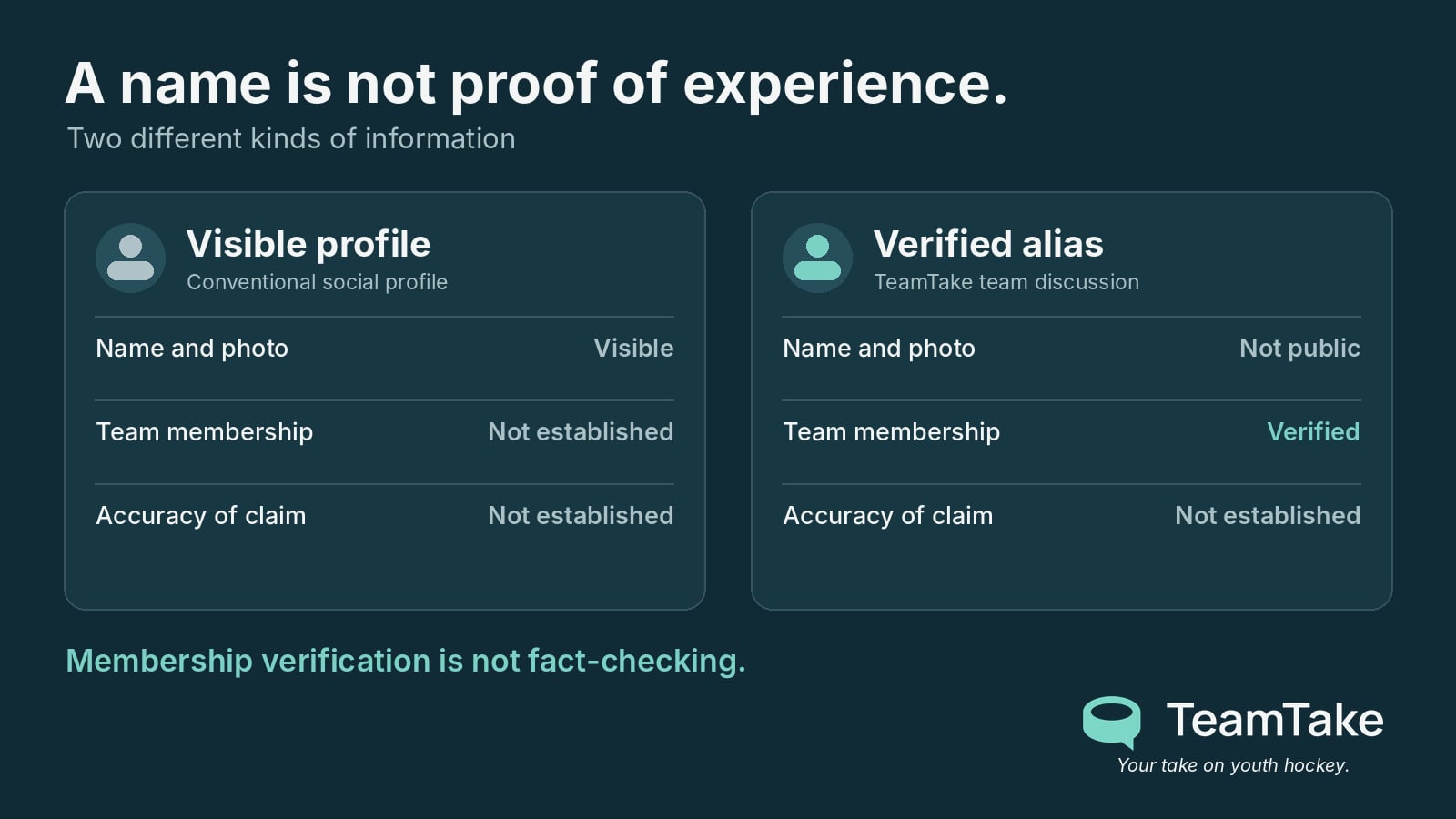
Knowing someone's name and knowing their connection to a hockey team are different kinds of information.
Of course, even verified team membership doesn't mean a person saw a particular incident or interpreted it correctly. A verified participant can be mistaken, biased or dishonest. Independent corroboration, relevant evidence and fair consideration of other perspectives still matter.
Verification establishes a connection to the community, not the truth of everything a person says.
If a claim is serious, ask for appropriate evidence or refer it to the proper process. If someone expresses an opinion, assess the reasoning behind it. If an account behaves abusively, report its behaviour. Demanding someone's public name is rarely a substitute for any of those steps.
Doesn't anonymity make people behave worse?
Sometimes it can. That is a real concern, and ignoring it would undermine the very argument for anonymity.
In 2004, psychologist John Suler described the online disinhibition effect. Reduced social restraints online can make people more comfortable doing things they wouldn't do face to face. This can have a constructive side: asking for help, expressing a concern, talking about something embarrassing. It can also have a destructive side: insulting strangers, spreading rumours or harassing others.
Removing anonymity doesn't automatically fix the latter problem. A 2016 study of online firestorms found more aggression among identified participants than anonymous ones in the particular setting studied. That doesn't establish that named users are generally worse; it shows that aggressive behaviour can persist even when identities are visible.
And a 2017 study of trolling found that negative mood and exposure to hostile comments could increase the likelihood of subsequent trolling. People take cues from their surroundings. If mocking the first anonymous poster becomes an accepted response, it's not surprising that others may join in.
The encouraging implication is that online communities don't have to accept those norms. A 2019 field experiment on Reddit found that making community rules visible could improve behaviour and encourage newcomer participation.
Good moderation matters whether the people participating use their real names or not. The standards should be the same: no harassment, threats, impersonation, baseless accusations or exposure of private information. People should be able to disagree, including strongly, without making the discussion personal.
Privacy is already part of everyday life
We don't ask people to announce their choices out loud when they vote. Many workplaces use anonymous feedback surveys, schools may collect anonymous evaluations of instructors, and organizations provide confidential channels to report misconduct. In each case, privacy serves a purpose. It helps separate someone's views from the pressure of their relationships with people who might be affected by those views.
Online privacy isn't unusual either. In a 2014 Pew Research Center survey, 42% of surveyed American adults reported having posted information anonymously, while 59% had used an associated username or screen name. These categories overlap, and the survey is historical rather than a measure of today's hockey groups. Still, it illustrates how long people have used different forms of identity online.
A 2024 study of workplace communication found that participants were more willing to speak up when anonymity was available, with psychological safety helping explain the relationship. The workplace is not a hockey rink, but the idea is familiar: people may express concerns differently when their identity is protected.
And there is no requirement to be anonymous everywhere. A person might be comfortable discussing equipment under their own name and prefer privacy when asking about an issue affecting their child. That's not a contradiction. Different conversations carry different risks.
What if we didn't have to choose between privacy and credibility?
In a 2022 Journal of Computer-Mediated Communication study, researchers examined what happened when people could hide their personal identity while displaying a relevant social affiliation. In the political-discussion setting studied, combining those two conditions improved some measures of rationality and civility. These results shouldn't be treated as proof that the same design will produce identical results in hockey communities, but the distinction is intriguing.
Knowing who a person is and knowing which community they belong to are separate things. Why insist on disclosing both when only one may be relevant to the conversation?
This is the thinking behind TeamTake. Rather than building another social network around public profiles and personal identities, we built a discussion platform around teams, organizations and hockey-related topics.
Members can verify their connection to a team by providing membership evidence, such as forwarding an existing TeamSnap email. They can then join private discussions with other verified members of their team and its organization. A random alias is used in place of a public name, and according to our privacy policy, aliases differ between discussions.
There are also public regional, organization and topic discussions that do not require verified team membership. Organization reviews are public, but the reviewer must have verified experience with the relevant organization through a team. Those different settings serve different purposes; a public discussion is not the same as a private team conversation.
Why does this matter? A broad Facebook group might be able to offer useful general advice, but its members may have no firsthand knowledge of a particular team's situation. Parents who actually belong to the team can compare experiences, ask whether something is a recurring problem and decide if it's worth raising together.
Sometimes that conversation will reveal that the concern is shared. Sometimes it will reveal a misunderstanding. Either can help.
If several families independently recognize the same problem, they may have more confidence approaching an organization together. That doesn't guarantee an outcome, but it can help move the conversation beyond individual frustration and hearsay.
Unlike spaces where anonymity is an exception, TeamTake doesn't require participants to justify why they prefer not to display a public identity. Privacy is part of how discussions work. Accounts still have rules, and members can report concerning content. Moderation may involve removing posts or restricting accounts. Read our About page, Privacy Policy and Terms for details.
Anonymity has limits. Use it responsibly.
A random alias can't prevent someone from recognizing a situation they already know about. In a team with two goalies, for example, a detailed description of one goalie's experience may make the family easy to identify, even without a name attached. A post may also be copied or shared by someone with access to it. TeamTake cannot guarantee complete anonymity or prevent retaliation outside the service.
You can still make thoughtful choices about what you disclose:
- Avoid posting names, jersey numbers, screenshots, schedules or other unnecessary identifying details about children and families.
- Start by describing the issue rather than the specific people involved. Say what you observed, distinguish facts from interpretation, and make room for other explanations.
- Check whether you're posting in a public or a verified-member discussion. Public content, including reviews, can be read and indexed outside the community.
- Don't post verification documents in discussions. Use the designated verification process instead.
- If someone mocks your choice to remain anonymous, you do not owe them personal details. Report harassment or attempts to expose private information where appropriate.
There is also a distinction between discussing a concern and reporting misconduct. Serious safety issues, abuse or harassment should be taken to the appropriate safeguarding or reporting authority, not simply posted online. In Canada, see Hockey Canada's safety resources; in the United States, see USA Hockey's SafeSport reporting guidance and the U.S. Center for SafeSport. The appropriate route depends on the organization and nature of the concern. If a child is in immediate danger, contact emergency services; follow applicable child-protection reporting requirements.
An anonymous discussion is a tool for exchanging information and finding support. It is not an investigation, a verdict or a replacement for formal reporting.
Next time someone asks, “Why are you anonymous?”
Perhaps a better question is: what would make this person comfortable speaking openly in the first place?
If their concern is reasonable, can we discuss it without demanding their name? If their account is incomplete, can we ask for clarification without treating them as a coward? If we disagree, can we explain why?
We should welcome respectful conversations between families and coaches. There are many good coaches who genuinely appreciate feedback, and many concerns can be resolved by talking directly. The problem is that not every family has the same experience or the same freedom to do that. A parent's choice to remain private doesn't mean they are unwilling to listen, take responsibility or support their child's development.
And if you're one of the parents who has hesitated to post because you didn't want to be judged for using an alias, you don't have to apologize for that choice. You're not alone. You can participate respectfully, ask honest questions and protect your family's privacy at the same time.
Challenge the argument. Not the anonymous author.
Hockey should be a place where kids can take risks, make mistakes and develop confidence. Their parents should be able to have reasonable conversations about how that experience is going without feeling that their children's opportunities are at stake.
Find your team or join the conversation at TeamTake.
Related reading: The Things Hockey Parents Don't Say Out Loud and When a Hockey Coach Becomes the Reason a Kid Quits.
TeamTake. Your take on youth hockey.
Comments
Be the first to comment.