TeamTake editorial
Are Hockey Academies Worth the Money?
KindHare199 · Published

How to compare hockey development, education, actual playing opportunities, family costs and long-term value before accepting an academy offer.
TeamTake Editorial | November 24, 2026 | Planning for 2027–28
A hockey academy can sound like the solution to several problems at once: better coaching, more ice time, organized strength training, stronger competition, a school schedule that works around hockey and exposure to the next level.
Then the tuition estimate arrives. Add travel, equipment, housing and a deposit that may be non-refundable, and the decision becomes one of the largest commitments a hockey family makes.
For some players, an academy provides exactly the environment they need. For others, a good local team and targeted training offer comparable or better personal development at a fraction of the cost. The answer depends on the specific offer, the alternative and the child's needs — not the reputation of academy hockey as a whole.
An academy fee buys a program of services and opportunities. It does not buy a guaranteed junior roster spot, a college scholarship or professional potential.
The question is what that program delivers, and whether those benefits justify the additional cost to your family.
1. Not all hockey academies sell the same thing
The term “hockey academy” can refer to several different arrangements. A school-based training option that complements a local minor hockey team is not the same purchase as a full-time boarding school with a competitive league team.
| Program model | Typical arrangement | What to verify |
|---|---|---|
| School-based skills academy | Training scheduled around school; player may compete separately for a local team | Whether team fees are separate; amount and quality of training |
| Full-time local academy team | Integrated schooling, hockey, strength training and league play | Academic provider, game schedule, transportation and included costs |
| Residential or billeted program | Player lives away from home to attend school and play | Housing, supervision, travel home, meals and support |
| Independent academy or club | Competitive team and/or development program outside some traditional systems | League status, registration rules, insurance, educational arrangements |
| Local rep team plus supplemental training | Separate school, team, skills coaching and gym | Coordination, schedule, quality and aggregate cost |
The Canadian Sport School Hockey League (CSSHL) FAQ describes education-based programming, aligned schools, academic monitoring and showcase competition. Its member programs are sanctioned by Hockey Canada or USA Hockey and the relevant members, but their schedules, services and prices differ.
Other leagues and independent programs may offer different models. In BC, for example, families may compare CSSHL programs, Junior Prospects Hockey League (JPHL) or North American Prep Hockey League (NAPrepHL) programs, BCEHL teams and local associations. Do not assume these are equivalent because of the words academy, AAA or Prep. See What Does AAA Actually Mean in Youth Hockey? and BC Youth Hockey Pathways: From U13 to U15 AAA and Beyond for the distinctions.
2. How much does academy hockey actually cost?
There is no meaningful single academy price. The following are published Canadian examples, not a market average, price ranking or endorsement. They illustrate different fee models and are not equivalent products.
| Published example | Listed cost (CAD) | Scope and caveats |
|---|---|---|
| Coquitlam Minor Hockey Association, BC | U15 $995–$1,045; A tryout $300–$350 | 2026–27 published registration and tryout amounts; not the full cost of rep hockey; team fees, equipment and travel may be additional |
| Pacific Coast Hockey Academy, BC | $23,000 plus GST, $650 school registration, $450 league player fee | Published 2026–27 amounts; billet cost listed separately at $10,000 if needed; some education, travel and other costs may be extra |
| CIH Academy, Ontario | $38,900 Canadian non-boarding; $49,900 Canadian student rate including applicable room and board | Published rates viewed Nov. 24, 2026; the fee page does not specify a season; mandatory extras listed separately |
The academy examples include different amounts of education, hockey, travel and living costs. The local association example is only an initial registration comparison. It would be misleading to divide academy tuition by minor hockey registration and call that the difference in total development cost.
Programs also differ in what they include. For example, Delta Hockey Academy's program description lists school-linked programming, team and specialist practice sessions, off-ice training, transportation and team travel arrangements. Ontario Hockey Academy's fee information identifies additional charges including tournament airfare and certain personal expenses. Ask for the complete written quote for your child's exact team and circumstances.
These are not confirmed 2027–28 offers. Obtain the new season's fee schedule, taxes, payment dates and written inclusions before paying.
3. Compare the total family cost, not just tuition
A local alternative may include substantial team expenses, private skills coaching and travel. An academy may bundle some of these costs but introduce others. To compare them fairly, use the same categories on both sides and include only expenses that apply.
| Annual incremental family expense | Local competitive team + supplemental training | Day academy | Billeted academy |
|---|---|---|---|
| Team/program fees, including assumed taxes and required school/league charges | $4,000 | $25,000 | $25,000 |
| Additional individual skills and conditioning | $3,000 | $1,000 | $1,000 |
| Equipment and consumables | $1,200 | $1,200 | $1,200 |
| Travel and tournaments not already included | $1,800 | $1,000 | $1,000 |
| Daily transportation / trips home | $1,000 | $1,500 | $2,000 |
| Billet housing and meals | $0 | $0 | $10,000 |
| Other school and personal expenses | $500 | $500 | $1,000 |
| Illustrative total | $11,500 | $30,200 | $41,200 |
These are invented, internally consistent planning scenarios in Canadian dollars, not quoted prices or typical national averages. Ordinary household and school costs common to all three options are excluded; adjust for any changes in food costs, tuition, financial aid or travel specific to your family. Do not count the same item twice if it is included in tuition.
In this example the day academy costs $18,700 more annually than the local option, and the billeted academy costs $29,700 more. The family should ask which additional services and opportunities justify that difference. It should also consider whether the commitment can be sustained for two or three seasons without depending on future scholarship money.
A hockey budget is more than a financial calculation. Driving, missed work, early mornings, weekends away and the needs of siblings matter. They are real costs even when no invoice arrives.
4. Does more ice automatically mean better development?
Academies often offer more structured ice time and strength training. For an athlete who can use that additional time productively, this can be a meaningful advantage. Strong coaches, well-designed drills, regular feedback, video and a competitive peer group may be difficult to assemble independently.
But ice time is a measure of input, not proof of improvement. Compare actual delivery rather than the advertised timetable.
| Ask about | Look for |
|---|---|
| Weekly ice | Scheduled versus delivered minutes, group size, cancelled or shared sessions |
| Coaching | Coach qualifications, time with the actual team, feedback frequency |
| Skill development | Individual priorities and transfer from drills into games |
| Strength and conditioning | Age-appropriate supervision, progression and recovery |
| Competition | Verified league schedule, opponent level, game role and number of games |
| Video | Who reviews it with players, how often and for what purpose |
| Progress | Baseline and follow-up assessments, realistic individualized goals |
Observe a normal practice, not just a recruitment camp. Watch how often a player is actually engaged, how coaches correct errors and whether drills require decisions under pressure. If multiple age groups share sessions, ask how the work is adapted to different ages and abilities.
Hockey Canada's U15 and U18 guidance offers a useful benchmark for skills, tactics and team play. It is not a guarantee that one particular training schedule will work for every athlete.
The American Academy of Pediatrics' 2024 report on overuse and burnout highlights risks when demands outpace recovery. An integrated program should manage the combined load from hockey, gym, games, travel and supplemental sessions. Persistent pain or exhaustion should not be treated as evidence that the program is working.
5. Meaningful playing opportunities: the part tuition cannot guarantee
A prospect may be recruited enthusiastically and end up in a smaller role than expected. This can happen in excellent programs as well as weak ones: other players improve, new recruits arrive, roles change and coaches make competitive decisions.
Before paying a deposit, ask how many players are expected at the position, what the likely initial role is, and how playing time is reviewed. Ask for the projected schedule and distinguish regular-season league games from exhibitions, tournaments and conditional playoff games.
For a goalie, a “40-game program” does not imply 40 games for that child. Two goalies sharing evenly might receive about 20 starts each, while a three-goalie roster or a designated starter arrangement can produce very different outcomes. Ask about dedicated goalie coaching, attendance of the actual coach, practice quality, shot volume, video review and competition for starts. No coach can predict every lineup months in advance, but a transparent policy is valuable.
The same applies to skaters. A strong depth role can have developmental advantages; a player who rarely plays meaningful minutes might benefit more from another environment. For additional questions, see Making the Team Is Just the Beginning: Understanding Playing Time in Youth Hockey.
6. Academics and the actual school day
Education-based hockey can reduce conflicts between classes and practices, and can make training more manageable than a schedule of late-evening ice times. But it is important to see how the education part works in practice.
Ask which school awards the credits, what curriculum and instructional model are used, how students receive teacher support, and how missed classes are managed during tournaments. If there is a hybrid or online model, clarify how much supervised instruction is available and how the student can access advanced courses or electives.
Request a sample week with school, ice, conditioning, travel, meals and homework. A student who wants an engineering or science degree may need a different course sequence from a student pursuing another field. A hockey schedule should not make essential graduation or university prerequisite courses inaccessible.
If NCAA hockey is an aspiration, check NCAA international academic requirements and the Eligibility Center directly. Canadian graduation and NCAA eligibility are related but separate questions. Ask who helps families maintain transcripts and verify course suitability; a school partnership alone is not proof of eligibility.
The commute test
Imagine a day academy requires 90 minutes of travel each way, five days per week. That is 15 hours of travel in a normal school week, before weekend games. A closer program requiring 30 minutes each way would use five hours, leaving ten additional hours for schoolwork, family time and recovery.
Those figures are hypothetical, but the calculation is simple and often overlooked. A school-day training schedule is only convenient if the whole day works. Confirm shuttle pickup and drop-off locations, waiting times, responsibility for transportation when schedules change, and arrangements during injury or exam periods.
7. Scouting and advancement: ask for a denominator
Academy websites often feature impressive alumni and commitments. These achievements can demonstrate that players from the program have reached higher levels. They do not automatically establish how much the program improved the chances of the average incoming player.
Established programs may recruit athletes who are already among the strongest in their age group. Those players might have advanced through several other routes. Selection effects make it difficult to attribute later success solely to academy attendance.
There is no reliable comparative estimate in the sources reviewed for this article that tells us how much paying for an academy increases an individual Canadian youth player's odds of reaching junior or NCAA hockey, compared with otherwise similar players choosing local alternatives.
College Hockey Inc.'s BC pathway analysis describes 125 BC players on NCAA Division I men's rosters in 2025–26 and shows the importance of established junior and school-based routes among those who made it. This is a study of successful college players, not all applicants to those programs. It cannot establish a program's causal effect or an entrant's advancement probability.
A simple example of why the denominator matters
Suppose two hypothetical programs both advertise eight players who advanced to a specified higher league in the last three seasons.
| Program A | Program B | |
|---|---|---|
| Unique eligible players in the same cohort | 40 | 100 |
| Unique players who advanced | 8 | 8 |
| Illustrative advancement share | 20% | 8% |
The same headline count produces very different proportions. Even those proportions would not prove Program A is better: the players' incoming ability, age, roster status, league strength and outcome definition may differ. Ask for complete cohorts and independently check subsequent roster participation rather than counting invitation letters or tryouts as commitments.
When discussing advancement, ask:
- How many players were eligible in each graduating cohort, and how many actually played regular-season games at the stated next level?
- Do the numbers include players who joined only briefly or were recruited after already receiving a commitment?
- What is the distinction between being drafted, listed, affiliated, invited to camp, verbally committed, signed and actually playing?
- What happened to players who did not advance, and can we speak with families whose experience was ordinary rather than exceptional?
A newer program may not yet have enough graduating cohorts to give meaningful numbers. That is a reason to price the uncertainty into the decision, not a reason to assume it will fail.
For more about the actual next steps, see Hockey Beyond U15: A Canadian Guide to Junior, College and Professional Pathways.
8. Billeting, safety and sanctioning are part of the product
If a player moves away from home, the academy's responsibility goes beyond providing practices and arranging a bedroom. Ask about how billet hosts are screened, household rules, meals, transportation, curfews, medical support and how a player can raise concerns privately or request a different placement. Confirm what happens during holidays, injuries or temporary school closures.
All families should understand who oversees the hockey program and what insurance, concussion protocols, staff screening and complaint channels apply. Hockey Canada's safety resources provide a starting point for understanding sanctioned hockey protections. Independently operated programs should explain their own safeguards and reporting processes in writing.
Sanctioning also affects hockey options. Under Hockey Canada's non-sanctioned league policy guidance, participation after the relevant cutoff can restrict certain same-season moves and affiliation. Regional rules may be broader; see BC Hockey's explanation. Confirm the exact rules for 2027–28 and the applicable league before signing. A program can be competitive without being sanctioned, but the difference must be understood.
For coaching and team culture, see How to Evaluate a Youth Hockey Coach Before Joining a Team and What Makes a Great Youth Hockey Team Culture?.
9. Read the contract before accepting the offer
A program's verbal description and written obligations may not be the same. Before paying, obtain the actual enrollment and hockey agreements, payment plan and refund policy. Ask which commitments are fixed and which are conditional estimates.
| Issue | Question to resolve in writing |
|---|---|
| Roster placement | Is this a confirmed team spot, conditional offer, waitlist or training-only place? |
| Staffing | What happens if the assigned coach leaves or the goalie coach changes? |
| Schedule | How are cancelled ice sessions, games or travel handled? |
| Transportation | What exact routes and services are included? |
| Injury or illness | What is payable during a prolonged absence? What medical support applies? |
| Withdrawal | Are deposits refundable? Are remaining installments still owed? |
| Program changes | What options exist if the roster, league, academic provider or program changes materially? |
| Financial assistance | Is aid guaranteed for the season? Is it conditional or renewable? |
For example, CIH Academy's fee page states that it reserves a student's place for the school year and requires parents or guardians to remit total tuition and hockey fees. Other programs can have different terms. Review the specific agreement rather than assuming a monthly payment plan means month-to-month cancellation is allowed.
This is practical due diligence, not legal advice. For a significant unclear contract or dispute, seek appropriate independent advice before committing.
10. When is an academy worth the money?
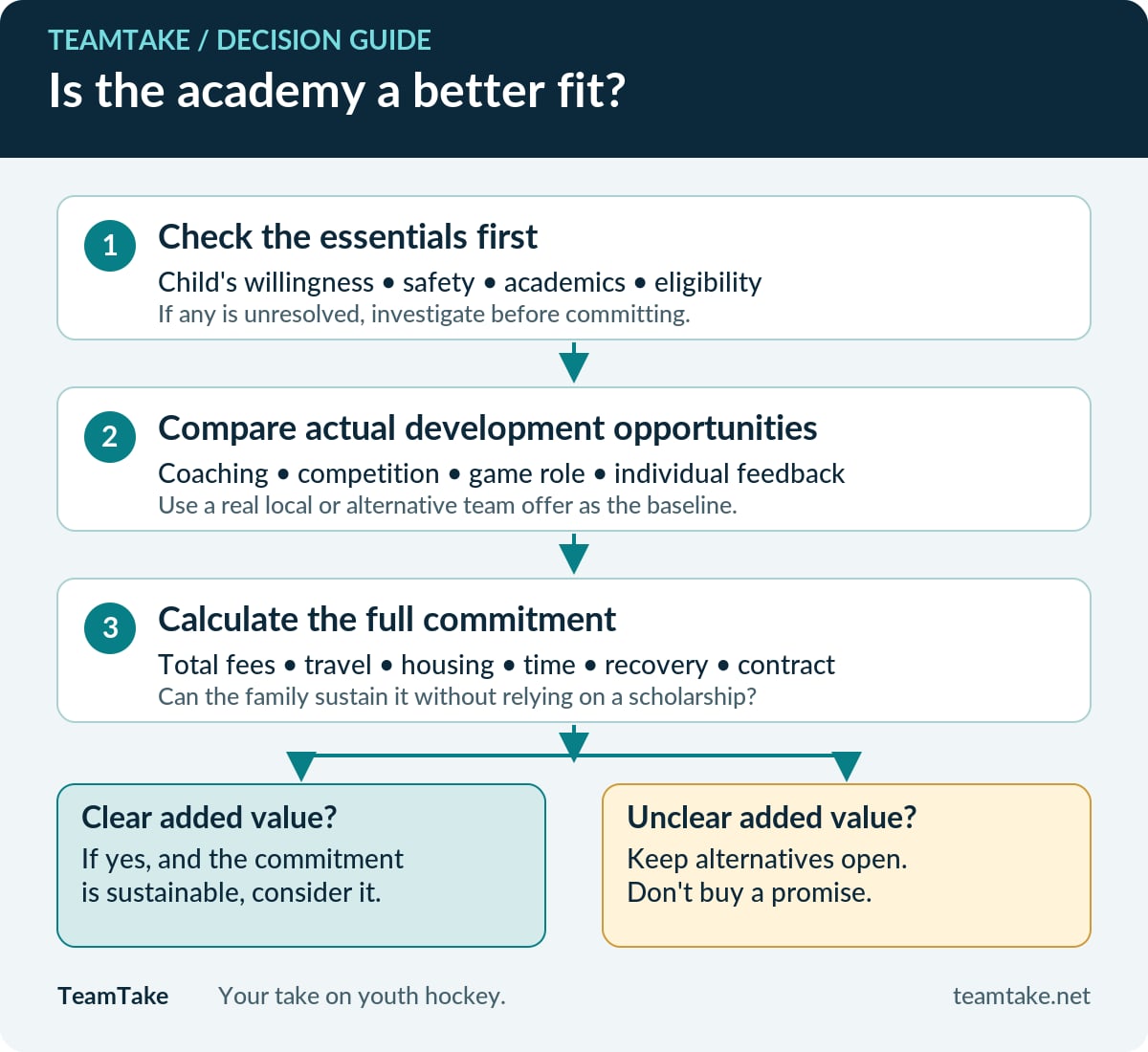
An editorial decision framework, not a rating of any particular academy.
An academy can be a strong choice when it provides a materially better combination of appropriate competition, useful training, individual coaching, genuine game opportunities and education than the family can realistically access otherwise. The child should want the arrangement, and the total cost and schedule must be sustainable.
A local program may be preferable when it already offers the right competitive challenge and a meaningful role, the main developmental gaps can be addressed with targeted coaching, or the academy would introduce substantial travel, financial strain or academic disruption without clear additional benefits.
Sometimes the choice is not between a great academy and a great local program. Families in smaller communities may have limited local options. In that situation, moving away or paying for integrated training may make more sense, provided the player is ready and the safeguards are sound.
Three hypothetical family decisions
The ambitious U15 skater: A local rep team offers regular ice, a reliable coach and challenging games. The academy offers better training facilities but an uncertain depth role and an exhausting commute. Staying local while addressing specific skating or puck skills may be the better fit this season.
The U17 player with limited local competition: The player consistently performs well at their current level but needs stronger opposition, more individual feedback and a structured school schedule. An affordable academy offer with verified game opportunities and a suitable academic plan may solve real problems.
The U15 goalie: A prestigious academy has three goalies competing for starts, while another team offers a clearer two-goalie rotation and regular specialist coaching. The less expensive option may be more valuable if it provides challenging games and useful feedback. The conclusion could change if the other team's competition or instruction is too weak.
None of these examples is a universal recommendation. They demonstrate why the most useful comparison is between actual offers for a particular child, rather than academy versus non-academy as an abstract debate.
The real measure of value
A hockey academy is worth considering when it can show what a family will receive, why those services matter for this player, and how it will deliver them across the season. The best programs should welcome informed questions about actual games, schooling, development and cost.
A higher fee may reflect more ice, specialized staff, private education, travel or housing. Those services have real costs. The presence of an expensive package does not make it a good investment automatically, just as a lower-cost option is not automatically inferior.
Buy the development environment your child needs today, not the future hockey career you hope the tuition will guarantee.
Join the conversation
For families who have tried both academy and association hockey: what was genuinely better, and what did not justify the extra cost? Did the reality match the original offer? What would you ask before committing again?
Share experiences on TeamTake or explore its academy discussions. Avoid identifying individual children and distinguish firsthand experiences from assumptions about other families or programs.
Sources and editorial notes
- CSSHL — FAQ and education-based hockey model
- Coquitlam Minor Hockey Association — 2026–27 registration fees
- Pacific Coast Hockey Academy — program, schedule and fee information
- CIH Academy — published tuition and fee terms
- Delta Hockey Academy — program inclusions
- Ontario Hockey Academy — tuition and extras
- Hockey Canada — U15 development guidance; U18 guidance
- American Academy of Pediatrics — Overuse Injuries, Overtraining, and Burnout in Young Athletes (2024)
- College Hockey Inc. — Paths: British Columbia and NCAA Hockey
- NCAA — International Student Initial Eligibility Requirements
- Hockey Canada — Safety Programs
- Hockey Canada — Non-Sanctioned Leagues Policy update; BC Hockey — Non-Sanctioned Hockey
TeamTake is an independent editorial platform. The named programs are examples of publicly listed fees and service models, not recommendations or judgments about program quality. Fee pages were reviewed November 24, 2026; figures may change and should not be treated as 2027–28 quotes. All comparative budgets and family scenarios are hypothetical. No academy-specific causal advancement claim is made.
Comments
Be the first to comment.