TeamTake editorial
Hockey Beyond U15: A Canadian Guide to Junior, College and Professional Pathways
EvenTurtle722 · Published · Updated
What comes after competitive U15 hockey? A practical guide to Canadian and American junior hockey, university and college recruitment, education and professional opportunities.
TeamTake Editorial | 2027 planning edition | Reviewed November 24, 2026
Scope: Canada-wide, with US opportunities; primarily boys’ and men’s competitive hockey. Planning for 2027 and the 2027–28 season. League structures and rules are based on the latest published information as of November 24, 2026; future schedules, rosters and season-specific policies must be confirmed.
At 14, a player can have ambitious hockey goals without having a fixed destination. Parents are often asked to choose between a local team, an academy and a move away from home before they understand how any of those choices relate to junior hockey, college or the professional game.
The landscape differs across Canada, but the fundamental decisions are similar: find suitable competition, build repeatable game performance, maintain academic options and evaluate actual opportunities rather than promises. This guide explains the shared system and highlights the differences that matter for regional planning.
For British Columbia families, our companion guide, BC Youth Hockey Beyond U15: From AAA and Prep to Junior Hockey, explains local programs and junior leagues in detail. Families at an earlier stage can read BC Youth Hockey Pathways: From U13 to U15 AAA and Beyond.
Three developments that matter when planning for 2027:
- Canadian major junior participation no longer automatically excludes players from NCAA Division I, subject to applicable amateurism and eligibility requirements, since August 2025.
- Junior hockey structures are changing: BC introduced a sanctioned Junior A conference in 2026, and Ontario began a new junior development pilot for 2026–27.
- The NCAA's age-based Division I eligibility model applies without the transitional choice of rules to first-time full-time college entrants from fall 2027. Waiting until 20 or 21 can reduce the time available for college competition. Plan the academic and junior timetable together.
1. The big picture: there is more than one path forward
The following diagram shows several possible development routes. Players do not have to progress through every level in a fixed order. What matters is developing the ability to compete at the next level, demonstrating it in games, and meeting selection, age, registration and eligibility requirements.
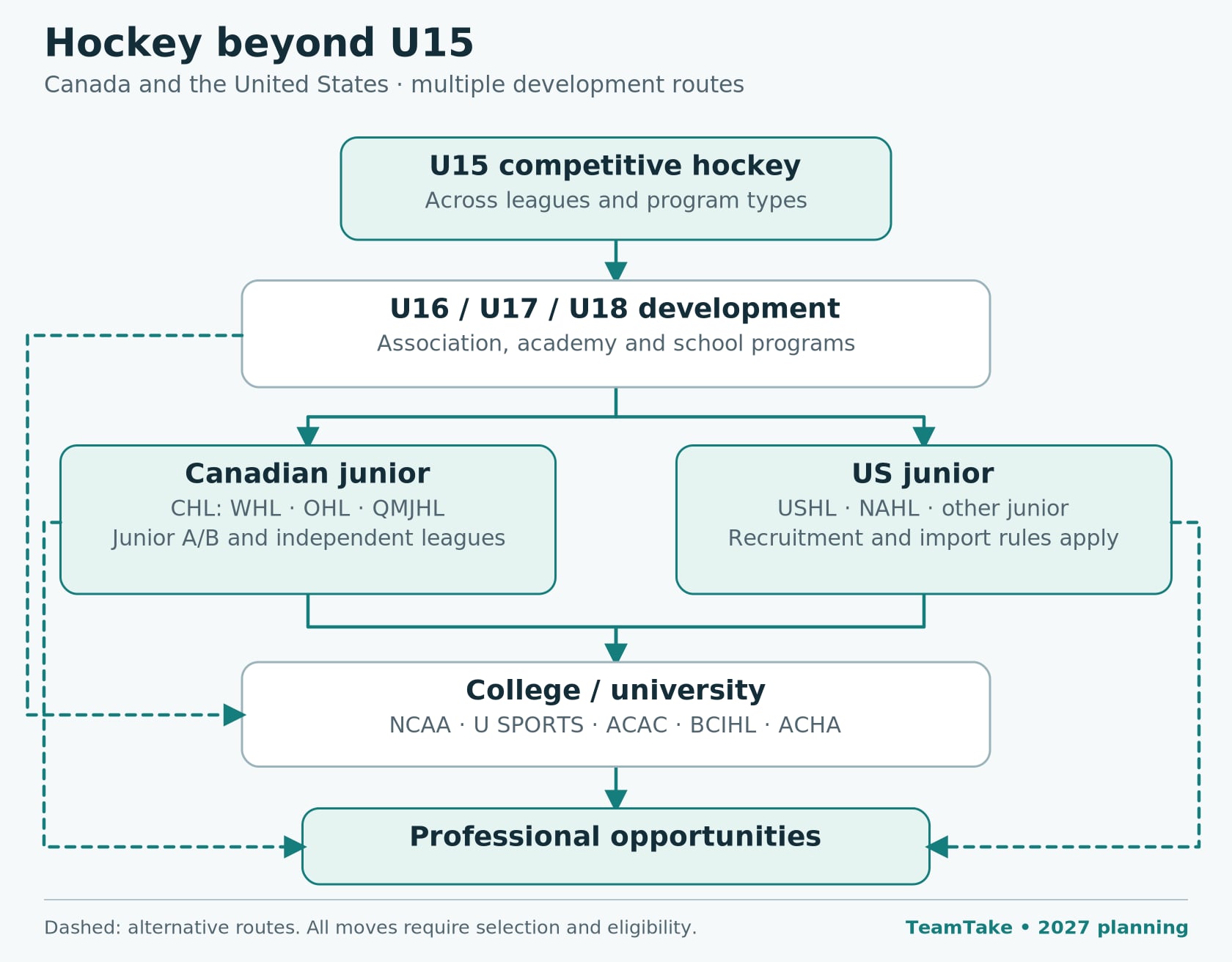
Figure 1. Common routes, not compulsory steps. Direct youth-to-college and junior-to-professional opportunities exist; every transition requires a suitable offer and eligibility.
There are several possible routes: elite players sometimes enter junior while still U18-aged; some move directly from U18 or prep to college; some sign professionally out of junior; many choose education, club hockey or adult recreational hockey instead. Junior B can feed Junior A, and Junior A can feed major junior, but playing at each level in order is not required.
Typical ages and decision points
| Age during calendar year of season start | Typical stage | Main decision |
|---|---|---|
| 13–14 | Competitive U15 or equivalent age-group hockey | Build skills and game experience; evaluate exposure and next-season options |
| 15 | First year U18 eligibility in Canada; U17, U16 or Prep depending on program | Find a strong developmental role; WHL draft year in the West; U16 scouting in Ontario and eastern regions |
| 16–17 | U17/U18, prep, high school; junior for selected players | Is junior genuinely a better opportunity than another year of youth hockey? |
| 18–19 | Junior, graduation, or post-secondary entry | Recruiting, academic admission, financial aid and NCAA eligibility planning |
| 20–21 | Final junior seasons or university | Decide whether remaining in junior justifies the cost to college eligibility or education timing |
| 18+ | Post-secondary and, for a small minority, professional hockey | Choose a suitable degree and competitive environment, or evaluate a concrete professional offer |
Canada normally assigns U18 to players aged 15–17 in the calendar year. US youth hockey commonly uses 15O (15-only), 16U and 18U. Age cutoffs, underage exceptions and roster limits vary. See Hockey Canada age divisions and BC Hockey junior hockey.
2. Choosing the next youth-hockey environment
U15 is usually followed by some combination of U16, U17 and U18, depending on the province and competition. The Hockey Canada U18 age group normally includes ages 15–17 in the calendar year of the season's start. Some leagues offer age-specific divisions; an academy or a US program may use different age labels. Verify the division and team, not just the school or league brand.
| Environment | What it can offer | What to investigate |
|---|---|---|
| Provincial AAA or elite leagues | High-level age-group competition, established scouting | Draw areas, selection, roster role, coaching, travel and affiliation |
| Accredited sport school / prep | Integrated education and hockey, showcases | Actual division, academic accreditation, games, cost and advancement |
| AA, A1 or local association | Meaningful role, school continuity, potentially lower costs | Competition quality, feedback, later AAA or junior opportunities |
| Independent academy or league | Alternative schedules and development programs | Sanctioning, transfers, insurance, verified competition and player outcomes |
| US 15O, 16U, 18U or prep school | Different development and recruitment market | Admissions, costs, immigration, housing and actual playing role |
AAA describes a competitive classification within a particular system; prep may describe a school-linked program or a named division. They overlap: a prep program can field elite-level teams, and an academy may offer more than one competitive division. See What Does AAA Actually Mean in Youth Hockey? for a fuller explanation.
A strong role at the appropriate level can be a better bridge to junior than a marginal role at a more prestigious one. At the same time, athletes targeting major junior or high-end NCAA programs eventually need evidence that they can perform against elite opposition. Choosing a lower level without a plan to close that gap is not the same as choosing a deliberately developmental environment.
Is elite U15 hockey a prerequisite for junior hockey?
Usually a competitive advantage, not a formal requirement. Strong AAA teams and elite academy or school-based programs are common scouting environments. Players learn to execute at higher speed and against stronger opponents. Those advantages matter, particularly for early major-junior recruitment.
Western Canada provides one useful example. The 2026 WHL draft illustrates the role of elite youth programs. The CSSHL reported that 85 current and four former players were selected. Players from provincial AAA programs were also prominent, and the official draft results included players from U15 AA in Saskatchewan. See the CSSHL's 2026 draft report and the WHL's first-round report.
That demonstrates where many early prospects play. It does not demonstrate that purchasing an academy place causes a draft selection, or that an AA player has no chance. These teams recruit already talented players, and their visibility differs. Draft counts also say nothing about the chances of an individual player without knowing the number of eligible athletes.
By U17 or U18, a player targeting high-end junior hockey will generally need to show that they can perform against credible elite opposition. If they are currently below that level, the practical next goal is to close that gap, earn a suitable role and accumulate evidence of performance. A later move to AAA, prep or junior B remains possible. Ontario also runs a separate U18 Priority Selection, with specific eligibility requirements; see the 2026 OHL U18 draft.
What scouts can evaluate: skating and pace; decisions under pressure; puck skills; positional execution; consistency; competitiveness; coachability; physical readiness; and, for goaltenders, tracking, movement, reads, rebound management and recovery. A label or highlight reel cannot substitute for repeated game performance.
3. Major junior: WHL, OHL and QMJHL
The Canadian Hockey League (CHL) is the umbrella organization for three major-junior leagues:
| League | Main region | Recruitment mechanism |
|---|---|---|
| WHL — Western Hockey League | Western Canada and western US | Prospects draft, player lists, scouting and subsequent signings |
| OHL — Ontario Hockey League | Ontario and neighboring US markets | Priority Selection and other league-specific acquisition routes |
| QMJHL — Quebec Maritimes Junior Hockey League | Quebec and Atlantic Canada | Entry draft, scouting and league-specific player acquisition |
The CHL primarily serves ages 16–20, with limited exceptional or underage participation. It is a major NHL scouting environment, with lengthy schedules and substantial travel. It is not professional hockey in the same sense as the AHL or NHL, and a WHL draft selection is not an NHL draft selection. See CHL recruitment.
Draft ages differ across the country
| League | Expected main draft cohort in 2027* | Typical scouting stage | What happens afterward |
|---|---|---|---|
| WHL | 2012-born (turning 15) | Competitive U15, including elite association and academy teams | Many return to U17/U18; selected players enter junior later |
| OHL | 2011-born (turning 16) | U16 AAA and accredited sport schools | OHL camp, youth or junior development; a separate U18 selection exists |
| QMJHL | Mostly 2011-born (turning 16) | M18/U18 elite and other eligible programs | Training camp, M18, junior or other development as appropriate |
*Expected cohorts are projected from the established draft-age rules and the last completed drafts, not a confirmation of 2027 eligibility or dates. Check the league announcements for 2027.
Sources for the established pattern: WHL 2026 Prospects Draft, OHL Priority Selection, QMJHL Entry Draft. Draft territory, residency, special selections and player-list rules are league-specific. Do not assume relocation makes an athlete eligible for a different draft.
A major-junior draft selection gives a team rights under its league rules. It is not a guaranteed contract, a starting position or an NHL draft selection. Players who are not selected may still develop through eligible acquisition routes, later drafts, youth hockey or junior leagues. Families should ask the team which rights it holds, what written commitment exists and what other opportunities remain open.
| Term | What it means | What it does not mean |
|---|---|---|
| Scouted | A team has observed or evaluated the player | The player has been offered a spot |
| Drafted / listed | A club holds or acquires league-specific player rights | A guaranteed contract or playing time |
| Camp invitation | A team wants to evaluate the player, or offers an open evaluation opportunity | A roster offer |
| Signed player agreement | Contractual relationship with specified obligations and benefits | A guaranteed starting role or permanent roster spot |
| Affiliated / AP | Eligible to appear with a higher team under applicable rules | Unlimited ability to move between teams |
At 15 or 16, families should ask about the rules governing underage games, affiliation, school arrangements and possible return to minor hockey. Do not extrapolate last season's game limits to a new season without confirmation.
Education and financial support in major junior
CHL teams generally provide a substantial player-support package rather than operating like tuition-based youth academies. The details depend on the player agreement and league. Scholarship programs can provide significant post-secondary support, but families must check eligible seasons, covered expenses, deadlines, institutions and interactions with other awards. See WHL Scholarship for an example; ask the specific OHL or QMJHL team for its current written terms. Do not assume a CHL scholarship pays the full cost of a private US university.
4. Junior hockey across Canada: regional structures
Junior hockey is a competitive age-based development system, not a school grade or a single league. Major junior, sanctioned Junior A and regional Junior B/C categories operate alongside independent leagues. The Canadian Junior Hockey League (CJHL) is an umbrella for established sanctioned Junior A member leagues, not another league a player joins. The Centennial Cup is the national Junior A championship; the Memorial Cup is the CHL championship.
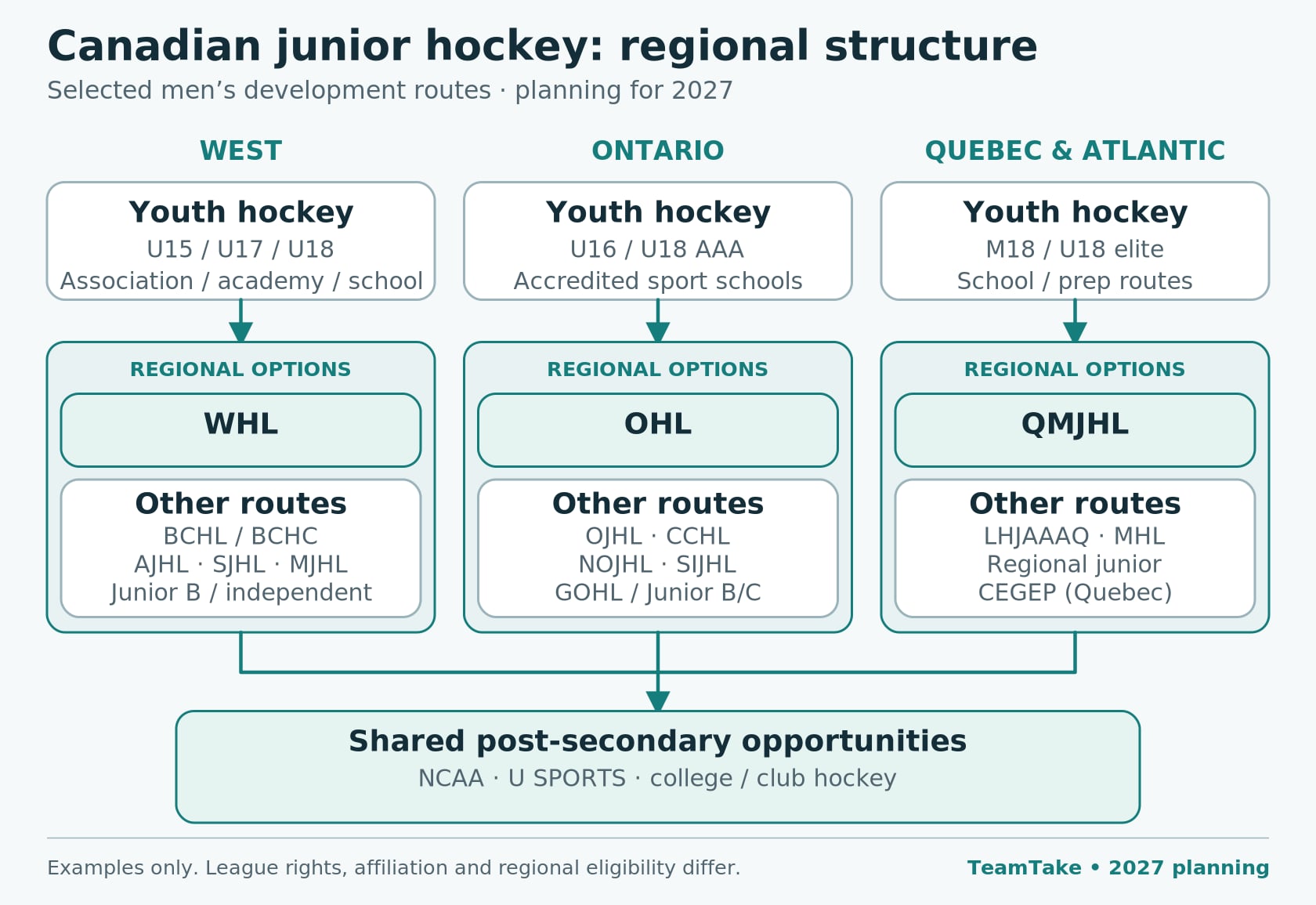
Figure 2. Examples of regional youth and junior systems, with shared post-secondary destinations. Boxes at the same height do not imply equivalent playing strength or identical rules.
| Region | Major junior | Selected junior options | Youth development context |
|---|---|---|---|
| British Columbia | WHL | BCHL (independent), BCHC (sanctioned A), PJHL (B), VIJHL and WIJHL (independent) | BCEHL U17/U18 AAA; CSSHL; JPHL; NAPrepHL; local U18 |
| Alberta | WHL | AJHL; independent BCHL clubs; Junior B | AEHL U17/U18 AAA, CSSHL and other school options |
| Saskatchewan | WHL | SJHL; regional junior B | U15 AA and U18 AAA pathways; prep options |
| Manitoba | WHL | MJHL; regional junior B | U18 AAA, regional elite and school programs |
| Ontario | OHL | OJHL, CCHL, NOJHL, SIJHL; GOHL and regional B/C | U16 AAA, U18 AAA, accredited sport schools |
| Quebec | QMJHL | LHJAAAQ; other junior leagues; CEGEP hockey as a distinct school route | M18 AAA, M17 elite and school hockey |
| Atlantic Canada | QMJHL | MHL; provincial junior leagues | U18 Major/AAA and U16 options depending on province |
| Northern territories | WHL territory includes Yukon and NWT | Often travel or relocation for higher-level opportunities | Local associations; check territorial residency and development rules |
These examples are not an exhaustive directory. See Hockey Canada’s Centennial Cup overview, CJHL current leagues and BC Hockey Junior. The 2026 Centennial Cup involved nine established CJHL leagues. The new BCHC is a sanctioned BC Junior A league; check the current championship qualification arrangement rather than assuming automatic participation.
Western Canada
The WHL draft generally arrives one year earlier than the OHL and QMJHL main drafts. In Alberta, the AEHL provides a sanctioned U15/U17/U18 AAA structure. Saskatchewan and Manitoba have their own provincial development systems; the 2026 WHL draft included Saskatchewan U15 AA players. School-based prep programs are another route, and teams may draw from multiple provinces. A player should verify draw zones and registration before moving or paying a deposit.
The Western Canadian Development Model connects sanctioned Junior A with the WHL and provides additional development mechanisms. The regional guide, BC Youth Hockey Beyond U15: From AAA and Prep to Junior Hockey, explains the BCHL/BCHC distinction and related Junior B options in depth. Check whether a proposed affiliation is actually available to the player, rather than relying on a general partnership announcement.
Other youth-development options in the West include the Junior Prospects Hockey League (JPHL) and the growing BC presence of the North American Prep Hockey League (NAPrepHL), which combines local games and showcase competition. Its 2026–27 activity is documented by Vancouver Whales Hockey Club and league expansion announcements. These are youth/prep competitions, not junior leagues; check each team’s age division, sanctioning, actual schedule, academic arrangements and player outcomes for 2027–28. The BC Youth Hockey Beyond U15: From AAA and Prep to Junior Hockey provides more detail. NAPrepHL is distinct from the US North American Prospects Hockey League (also called NAPHL), which is associated with the NAHL.
Ontario
Ontario's U16 AAA season is especially relevant to the OHL Priority Selection. Families should distinguish the regular U16 draft from the separate OHL U18 selection, which has specific registration and protected-list eligibility conditions. Junior options are geographically distributed: OJHL, CCHL, NOJHL and SIJHL serve different markets. GOHL and other regional junior programs can also be appropriate developmental destinations.
A Hockey Canada-approved Ontario development pilot for 2026–27 brings the OHL and participating junior leagues into a more coordinated framework. One provision allows an OHL club to designate a qualifying 16-year-old 2026 draft pick assigned to Junior A/B for expanded affiliation of up to 34 games. This is a specific pilot exception, not a universal right for all 16-year-olds. For 2027–28, verify whether the pilot continues and what its new terms are. Ask how games are counted and how the player’s school schedule is protected.
Quebec
Quebec commonly uses M15 and M18 terminology (equivalent age categories to U15/U18). M18 AAA is a major scouting environment, while other elite and school programs offer additional routes. Junior AAA (LHJAAAQ) is a junior classification, not the same as M18 AAA. Quebec also has a distinctive CEGEP education system after secondary school, with competitive collegiate hockey through RSEQ. The choice between major junior, Junior AAA and CEGEP should account for the athlete's academic program, hockey role and eligibility.
For families considering NCAA hockey, confirm how the actual CEGEP enrollment and prior coursework will be treated by the NCAA Eligibility Center. Do not assume that enrollment in a Canadian post-secondary institution is invisible to the eligibility clock. Check the school's registrar and NCAA compliance before enrolling.
Atlantic Canada and northern communities
The QMJHL and MHL are important routes in Atlantic Canada, with provincial U18 Major/AAA and school options; for example, Hockey Nova Scotia lists U18 Major and U16 AAA leagues. The exact system differs across Nova Scotia, New Brunswick, Prince Edward Island and Newfoundland and Labrador. Travel distances, billet arrangements, schooling and access to high-level opposition may be particularly consequential. Northern families can face similar constraints. The most practical pathway may be a local season followed by a targeted move when a real roster opportunity arises.
Sanctioned versus independent: why it matters
Sanctioning is not a guarantee of coaching quality, nor does independence automatically mean low-level hockey. It does affect registration, transfer and affiliation rules, insurance, disciplinary and safeguarding channels, and which championship or development structures apply. NCAA academic and amateurism eligibility is a separate determination. Ask the current governing body and receiving league for written transfer guidance before committing. A coach's assurance that “you can always come back” is not sufficient.
5. Playing junior hockey in the United States
US junior hockey is distinct from American high school and college hockey. Juniors recruit teenage and young adult players, generally 16–20, and many graduates progress into college programs.
| League | Classification | General financial model | Typical next opportunities |
|---|---|---|---|
| USHL — United States Hockey League | USA Hockey Tier I | No playing tuition; substantial club-funded support | NCAA DI, professional scouting |
| NAHL — North American Hockey League | USA Hockey Tier II | No playing tuition; player generally pays billet and personal costs | NCAA DI/DIII, sometimes USHL or other junior |
| NA3HL — North American 3 Hockey League | USA Hockey Tier III | Usually tuition-based plus housing | NAHL, college and other junior opportunities |
| NCDC — National Collegiate Development Conference | Independent USPHL top junior division; uses its own tier terminology | Advertised tuition-free; confirm housing and other expenses | NCAA, higher junior and other opportunities |
| USPHL Premier / Elite and other independent junior programs | Independent structures | Generally fee-based; varies by club | Development, other junior and collegiate hockey |
See USA Hockey's junior overview, NAHL recruiting FAQ, and USPHL's league overview. The Eastern Hockey League (EHL) and its Premier division also operate primarily in the eastern US, with a college-oriented development model. See the 2026–27 EHL schedule announcement. Verify each league’s current sanctioning and fee structure before committing, rather than relying on an old tier chart.
USHL and NAHL recruitment
The USHL draft has two phases. Phase I targets the younger eligible birth cohort (normally turning 16 in the draft year; confirm the 2027 cohort); Phase II covers other junior-eligible players. Teams also use tenders, protected lists and camps. The USHL is highly selective.
The NAHL uses tenders, drafts and tryout camps. A tender ties a prospect's rights to a club within that league. A player who goes undrafted or untendered can contact teams about evaluation opportunities. The league's current recruiting FAQ states that teams can carry up to four non-US citizens on their protected list, so Canadian prospects should ask whether the club actually has an import opening. Confirm how dual citizenship is treated and whether the rule changes for the relevant season.
One important restriction to check before choosing a US program for 2027–28: the NAHL announced on March 26, 2026 that players competing in a US junior league outside USA Hockey sanctioning are ineligible to play in the NAHL during that league year. This announcement specifically concerns US-based unsanctioned junior competition; confirm applicability to any cross-border league, Canadian team or individual transfer with the registrar. Confirm whether this rule remains in force for the season in question. Do not assume that an independent US program provides a seamless in-season route to the NAHL.
Does moving to the US improve NCAA chances?
Not automatically. A player may gain stronger opposition, a particular coach, a meaningful role or access to an established scouting market. But NCAA programs also recruit Canadian junior and major-junior players.
College Hockey Inc.'s BC pathway study examined 125 BC players on 2025–26 men's Division I rosters. Roughly 88% had secured their commitment while playing junior hockey, and the average commitment age was 19. The study points to the importance of BC-based development, particularly through the BCHL and WHL. Its Ontario study found similarly diverse routes.
These are retrospective studies of successful college players, not odds of reaching college from a given youth team. They also mostly reflect recruiting before the new age-based NCAA eligibility system fully takes effect. Future recruiting patterns may be different.
For a 15-year-old in BC, moving to the US should solve a specific problem or provide a concrete opportunity. It is not a prerequisite for playing college hockey in the United States.
6. What is the destination? NCAA, Canadian university, club or professional hockey
The words college, university, junior and professional are often mixed together. Here is what they actually describe.
| Destination | What it is | Academic / financial considerations |
|---|---|---|
| NCAA Division I (DI or D1) | Highest NCAA men's varsity competition; elite national and international recruiting | Admission, NCAA certification and roster offer; athletics aid may be available |
| NCAA Division III (DIII or D3) | Competitive varsity hockey at colleges and universities | No athletics scholarships; merit and need-based aid may be available |
| NCAA Division II | A separate NCAA institutional division; very limited men's hockey competition | Some DII schools sponsor DI hockey; verify the actual hockey program |
| U SPORTS | Canadian university varsity hockey | University admission, eligibility and possible athletic financial awards |
| ACAC | Alberta college-level athletics, including men's hockey | Institution-specific admissions, programs, fees and awards |
| BCIHL | BC intercollegiate hockey | Institution and team-specific structure; check current membership and eligibility |
| ACHA / other US collegiate club hockey | Non-NCAA collegiate hockey, with several competitive divisions | University enrollment and club eligibility; team dues and aid vary |
| NHL, AHL, ECHL, European leagues | Professional hockey | Employment/contract, player rights, immigration and impact on future college eligibility |
The ACHA has its own Division 1, 2 and 3 men's competitions. ACHA Division 1 is not NCAA Division I. It can be an excellent way to combine strong hockey with a particular degree, but funding, training schedules and institutional support vary. See the ACHA overview.
NCAA Division I: roster spots and scholarships
NCAA men's hockey is not a continuation of the junior league's roster. A university coach must have a role for the player, the institution must admit the student, and the athlete must meet the eligibility rules.
Under the House settlement framework introduced in 2025–26, participating DI programs generally operate with a 26-player roster limit (with transitional exceptions) and may fund up to 26 full-equivalent athletics scholarships. That is a ceiling, not a promise that every school funds every player. Non-participating institutions and conferences may have different policies. See College Hockey Inc.'s House settlement FAQ.
Ivy League schools, for example, do not offer athletic scholarships, although eligible students may receive financial aid. A full scholarship, partial award, need-based aid and an unsupported roster invitation are four very different financial outcomes. Ask the school for its written annual net cost and renewal terms.
Canadian university hockey: an option, not a consolation
U SPORTS men's teams often recruit players with substantial CHL and Junior A experience. The level of competition can be exceptionally strong. Western Canadian examples include the UBC Thunderbirds in Canada West. Other conferences include the OUA in Ontario/Quebec and AUS in Atlantic Canada.
U SPORTS generally allows five years of competition, subject to academic eligibility, prior competition and other rules. The UBC eligibility overview is a useful starting point. Confirm transfer, prior professional participation and any interaction with NCAA eligibility directly with the relevant university. A CHL scholarship may help cover costs, but activation and payment conditions should be confirmed before making a choice.
Other collegiate paths include the ACAC and BCIHL, where program structure and admissions differ. A player does not need to abandon competitive hockey simply because they do not receive an NCAA or U SPORTS offer.
7. NCAA eligibility: two rule changes that reshape the junior-to-college decision
Major junior is no longer an automatic barrier
Before the 2025–26 season, CHL participation was generally incompatible with NCAA DI men's hockey. On November 7, 2024, the NCAA announced a change effective August 1, 2025, allowing major-junior participation before college without automatic disqualification, provided compensation remains within permissible participation expenses and other requirements are met. NCAA announcement.
This removes a longstanding reason for families to choose BCHL instead of WHL solely to preserve NCAA DI eligibility. It does not mean every contract, bonus, sponsorship or professional arrangement is allowable. Disclose payments, agreements and agent involvement to the NCAA Eligibility Center and the prospective school's compliance office.
Division III separately removed its special major-junior participation penalty for players enrolling from August 1, 2025 onward. Its other amateurism and delayed-enrollment requirements remain distinct. See NCAA Division III Proposal NC-2026-8.
The NCAA age-based model: what changes for college entry from fall 2027
For a young player today, the second change may be even more consequential.
Under the new DI model, the five-year eligibility window begins at the earlier of first full-time enrollment and attendance at any post-secondary institution, or the qualifying fall academic term after the player's 19th birthday. Players who turn 19 on or after September 1 generally start at the following academic year's fall term unless they enroll full-time earlier.
The clock continues during non-participation and normally during injury, transfers or additional junior seasons. It is not a bank of five playing seasons that can be saved indefinitely. Limited exceptions exist. For families planning ahead, first-time full-time college entrants in fall 2027 or later are subject to the new model alone. The 2026–27 intake has transitional treatment under which the more favourable model applies.
Illustration: a player born in spring 2013 (hypothetical; assumes continuous eligibility and unchanged rules):
| Event | Academic year | DI window remaining at fall entry |
|---|---|---|
| Final U15 season | 2027–28 | Not started |
| Typical Grade 12 graduation, June 2031 | 2030–31 | Not started, assuming no earlier full-time college enrollment |
| Age 19 in spring 2032; starts college that fall | 2032–33 | Up to five years |
| Remains in junior for one more season; enrolls fall 2033 | 2033–34 | Up to four years |
| Remains in junior again; enrolls fall 2034 | 2034–35 | Up to three years |
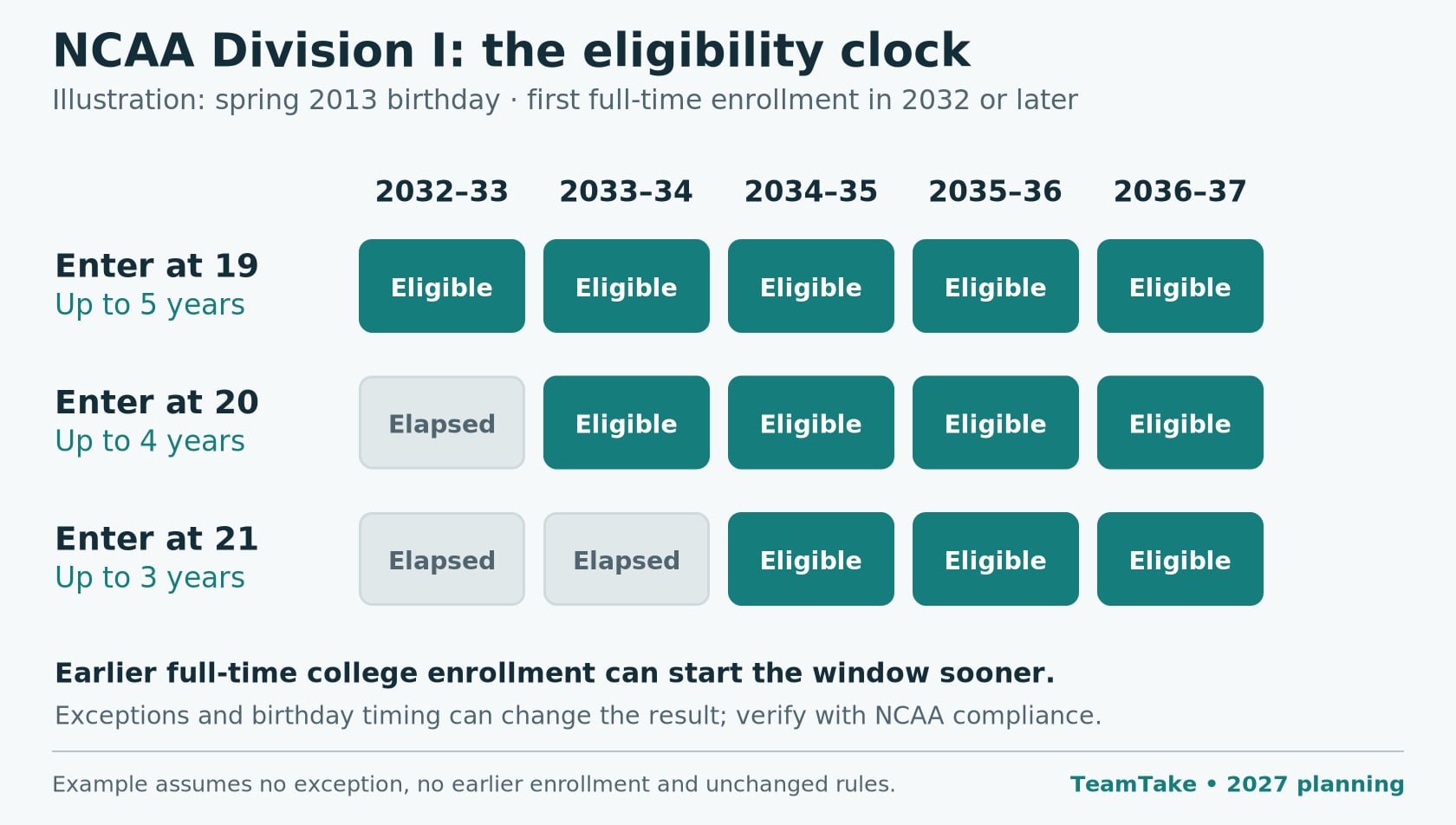
Figure 3. Example only: spring 2013 birthday, no earlier full-time college enrollment, no exception and unchanged rules.
This is an illustration of the current rule, not a prediction of policies in 2032. A September-to-December birthday or earlier full-time enrollment can alter the calculation. The official sources are the NCAA age-based eligibility explanation and College Hockey Inc.'s hockey-specific guidance. Division III has separate rules; do not apply this diagram to DIII or U SPORTS.
What does this mean in practice? An extra junior season may still be the best choice if it creates a real opportunity to be recruited or play a meaningful college role. Three or four years at a suitable college can be more valuable than five years of eligibility with no roster offer. But families should now weigh that tradeoff explicitly. Full-time enrollment in a Canadian college or an online university program while playing junior can also start the NCAA clock; ask compliance before enrolling.
8. Academic and recruiting prerequisites: start in Grade 9
A strong hockey player still needs to qualify as a student. For NCAA DI, the international eligibility requirements specify 16 qualifying core-course credits, at least a 2.3 core-course GPA, proof of graduation and official academic records beginning in Grade 9. Canadian province-specific credential rules apply. This is the NCAA minimum, not the admission standard of every university or the GPA needed for competitive academic programs.
| School stage | What to do |
|---|---|
| Grade 9 | Confirm graduation plan and NCAA-compatible courses, especially in academy or online school settings; retain records |
| Grades 10–11 | Review credits, establish academic goals, research universities, prepare accurate hockey profile and begin permissible recruiting communication |
| Grade 12 | Apply to schools as appropriate, arrange transcripts, confirm eligibility and admission requirements; plan junior and college timeline |
| Junior after graduation | Maintain academic readiness; avoid casual full-time college enrollment without eligibility advice; confirm entry term and admissions deadlines |
| Before enrolling | Obtain written roster/aid details, complete required eligibility certification, verify immigration status and confirm total cost |
Register with the NCAA Eligibility Center as appropriate. Canadian applicants should check their province's credential guide; standardized testing and English proficiency requirements may still depend on the university even if not required by the NCAA initial eligibility formula.
How do NCAA coaches recruit?
There is no NCAA entry draft. Coaches evaluate prospects, communicate with eligible recruits, make offers and recruit to specific roster needs. Current men's hockey recruiting guidance allows recruiting conversations from January 1 of Grade 10 and verbal offers beginning August 1 before Grade 11. Rules and calendars may change; see College Hockey Inc.'s recruiting guide.
A verbal commitment is not the same as formal admission, a written aid agreement or a guarantee that the coaching staff and roster will remain unchanged. Before agreeing to a school, understand the exact entry year, conditions, anticipated role, scholarship terms and what happens if the coach leaves.
Build a simple hockey profile: birth year, graduation year, team and league, position, verified statistics, full-game footage, a brief highlight video, coach contacts and academic information shared privately. Target teams and schools whose needs and admission requirements match the player. An introduction from a credible coach can help; expensive recruiting services and paid exposure camps are not prerequisites.
If hiring a family advisor, ask about fees, conflicts, references and specific deliverables. Have the school's compliance office review the proposed agreement before any agent representation, compensation or professional negotiations. NCAA exceptions exist, but their applicability depends on the facts. Never accept a guarantee of scholarship or draft selection in exchange for payment.
9. Goalies: why the same pathway can have a different timeline
Goaltending is different from skating positions in several practical ways. A team has many skaters but usually only two or three goaltenders on its roster. Only one is playing at a time. Being offered a roster spot at a prestigious level does not necessarily mean a young goalie will get enough meaningful game experience.
What historical NCAA goalie data tells us
College Hockey Inc.'s 2024 goalie pathway study examined 201 men's Division I goaltenders on 2023–24 rosters. Their college commitments came from numerous leagues and levels. Selected examples:
| Level or league when commitment was made | Goalies in the study |
|---|---|
| NAHL | 61 |
| USHL | 34 |
| BCHL | 21 |
| AJHL | 12 |
| NCDC | 11 |
| Prep school | 10 |
| Other / unknown | 52 |
| Total | 201 |
Around 60% of the goalies had been playing 18U, prep or high school hockey at age 17. This study predates the 2025 CHL eligibility change and the 2026 NCAA age-based model. It therefore cannot tell us how today's WHL goalies will compete for future college spots, nor what the best future commitment age will be. It does show that not making junior at 16 or 17 has not historically been a disqualifier.
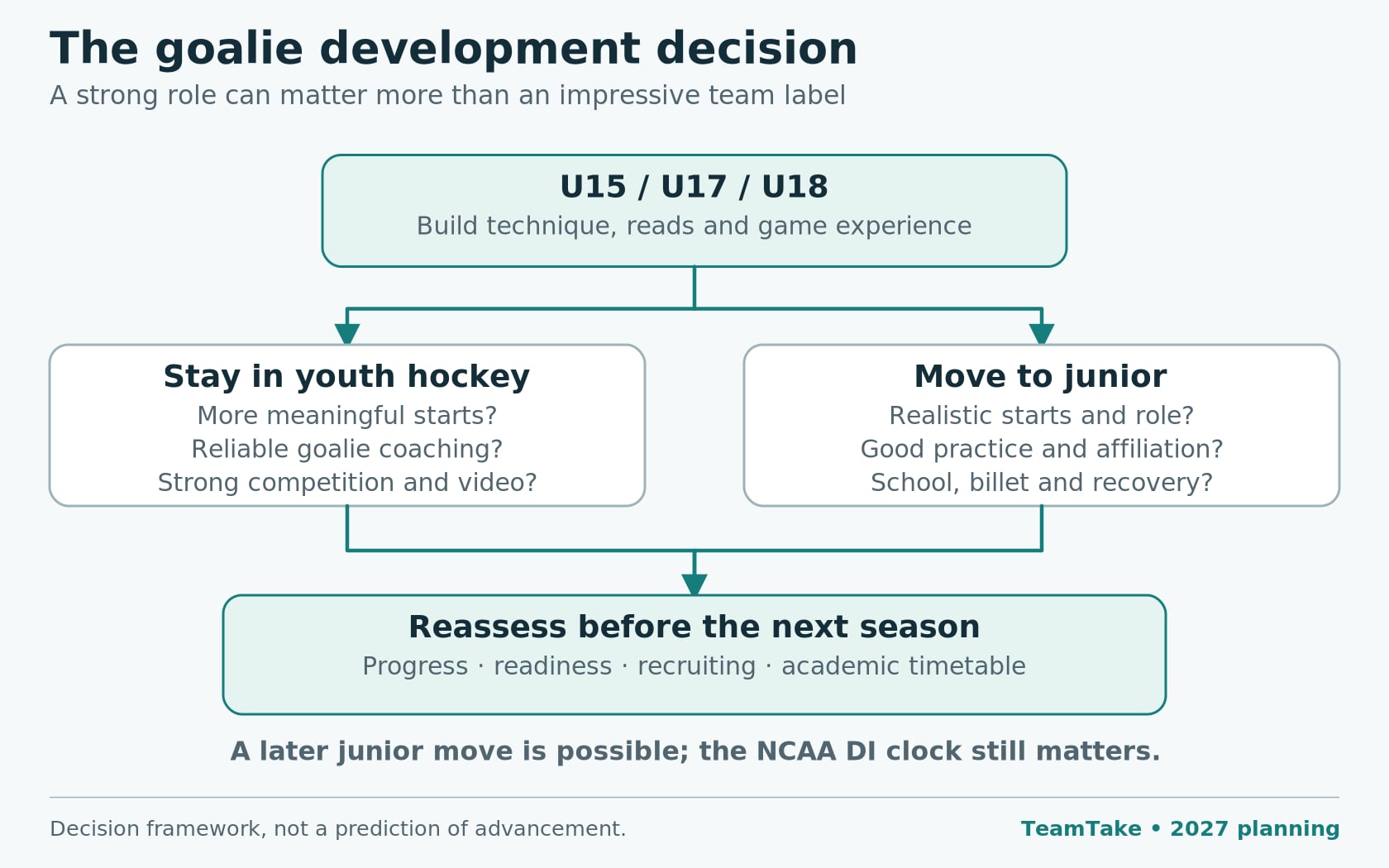
Figure 4. Evaluate the role and progression plan rather than assuming the highest available league is always the best next step.
The goalie development tradeoff
Consider two illustrative offers for a 16-year-old goalie:
| Offer A: higher-level junior team | Offer B: strong U18 AAA / Prep team | |
|---|---|---|
| Expected starts | 8–12 | 22–28 |
| Competition | Older, faster players | Strong age-group opposition |
| Goalie coaching | Verify weekly access | Verify weekly access |
| Possible advancement | Higher-level exposure; limited games | More starts and full-game video; later junior opportunity |
These are hypothetical numbers, not prescribed minimums. Offer A may make sense if the organization has an exceptional goalie development plan, suitable affiliation and a genuine route to more starts. Offer B may be the better environment if the athlete needs game experience and regular technical work. Evaluate practice shot quality, feedback, recovery and physical load as well as games.
Before accepting a spot, ask who else is signed or returning, whether the team expects to add another goalie, who decides starts, how affiliation works, whether the goalie can play games elsewhere, and whether there is dedicated goalie instruction. Ask how many games each of the team's goalies actually played in the last two seasons, and what happened to the goalies who were released or did not advance.
Goalie scouting should account for shot quality, screens, traffic, rebound situations and technical decisions rather than relying solely on wins or save percentage. Keep full-game footage, including routine saves and goals against. Height and physical projection can influence scouting at higher levels, but there is no universal height threshold that substitutes for performance or automatically determines a child's future.
The new college clock creates a real tension: some goalies benefit from later development, but staying in junior past the qualifying 19-year-old academic term can now reduce DI eligibility. For a goalie who is 17 or 18, it is worth discussing the expected junior role and college timetable together, rather than treating them as unrelated decisions.
10. The professional route: NHL, AHL, ECHL and beyond
NHL clubs draft eligible players under NHL rules (the typical first eligibility year is when the player turns 18 by September 15). The NHL draft is separate from the WHL or USHL drafts. Being drafted grants rights; it does not guarantee an NHL contract or appearance. Undrafted players can also earn professional contracts later.
The American Hockey League (AHL) is the primary NHL development league, not an amateur junior league or a college scholarship program. The ECHL is also professional. An athlete may pursue professional hockey after major junior, NCAA or Canadian university hockey, or through European and other professional leagues. Opportunities depend on contracts and performance, not simply age.
The AHL's general minimum age is 18 by September 15, but CHL-to-AHL movement has additional restrictions. Starting in 2026–27, certain 19-year-old CHL players selected in the NHL draft's first round can be assigned to the AHL under the updated arrangements. This is a narrow exception, not general permission for every 18- or 19-year-old junior player to join an AHL team. See the NHL's October 2026 prospect report.
How realistic is a professional outcome?
The CHL, USHL, NCAA and other competitive leagues produce NHL players, but those who reach professional hockey represent a small share of all children who start playing. Even being drafted is not the same as establishing a professional career. The NCAA's participation and professional probability resource explains the limitations of its estimates, especially in sports where many youth athletes play club hockey rather than school hockey.
Do not use the percentage of NHL players who came through a league as the probability of a U15 child reaching the NHL. These are different populations. A successful development plan can pursue high performance while preparing for a worthwhile life and education regardless of the hockey outcome.
11. Living away from home: billets, school and safeguarding
A billet family is a host household that provides housing, typically meals and a home environment for a player living away from their own family. Some academies use residences or dormitories instead. Billeting is common in junior hockey and may begin while a player is still a minor.
Before a minor relocates, speak directly with the team, school and prospective billet family. Ask for written policies covering:
- Screening and supervision: background checks of adults, household suitability, bedroom privacy, boundaries, curfews, transport and monitoring.
- Education: enrollment, attendance, tutors, exam scheduling, missed classes, internet access and whether courses support future university admission.
- Health and safety: medical insurance, emergency contacts, access to medical care, concussion protocols, mental-health support and authority to consent to treatment.
- Conflict and exit procedures: confidential reporting independent of coaches, changing billets, travel home, release or trade arrangements, refund rules and what happens if a player is injured or cut.
- Practical living: food, allergies, laundry, quiet study time, transport, distance from the rink, equipment storage and costs.
For a younger player, being away from home should not be treated as proof of commitment. Some athletes thrive in a billet arrangement; others develop better while living at home. A teenager needs adequate sleep, nutrition, relationships outside hockey and appropriate adult support, regardless of league.
Cross-border moves for Canadian families
Canadian citizenship is not blanket permission to reside, attend school or work in the United States. A Canadian athlete attending a qualifying US school generally needs student status, a valid Form I-20 and the appropriate SEVIS procedures, even though Canadian citizens are usually exempt from obtaining a student visa stamp. See the US Department of State's student visa guidance.
Junior hockey immigration arrangements depend on the exact activity, age, schooling, citizenship, compensation and team. Ask the team's immigration specialist and school international office which status is appropriate before crossing the border or paying non-refundable fees. Do not assume tourist admission is appropriate for a full season. Canadian permanent residents who are not Canadian citizens may face different rules. Confirm any international hockey transfer with the relevant league and governing bodies, plus medical coverage, guardianship arrangements and parental travel consent.
College athletes considering paid work, endorsements or name/image/likeness (NIL) opportunities must also verify immigration restrictions separately from NCAA permission. A benefit permitted by sports rules is not necessarily lawful under the athlete's immigration status.
12. What will it cost?
Junior hockey is not uniformly free or pay-to-play. Some clubs cover major expenses; others charge substantial fees. Always compare the total annual family cost, not just the published player fee.
| Route | Common cost model | Ask for written confirmation of |
|---|---|---|
| WHL / major junior | Club-supported participation, with education and housing benefits under player agreement | Scholarship value, claim conditions, personal costs |
| BCHL / BCHC / Canadian Junior A | League and team-specific fee and benefit arrangements | Registration, equipment, billets, insurance, team travel and refunds |
| Junior B or other local junior | Often player-funded in part or in full | Fees, local travel, billet cost and equipment |
| USHL | No playing tuition, substantial team support | Billet, equipment, medical and personal costs |
| NAHL | Tuition-free hockey; player normally pays room and board | Monthly billet charges, equipment, insurance and travel home |
| NCDC | Advertised tuition-free | Housing and food, equipment, transport, mandatory extras |
| Fee-based US junior / prep | Tuition, fees and housing can be substantial | Actual total cost and what is refundable if cut |
| University / college | Tuition, housing and living costs less confirmed aid | International fees, aid renewal, summer housing, books, health coverage |
The NAHL's FAQ lists an illustrative billet charge of US$400–450 per month. Over eight months that is US$3,200–3,600, before equipment, travel home, insurance and personal costs. This is a league-published estimate, not a current quote from every team. Verify the actual charge and any exchange-rate exposure.
A useful budget worksheet is:
Annual family cost = player fees + school tuition + housing/billet + uncovered meals + equipment + training + insurance + travel + camps + personal costs − confirmed awards − costs actually covered by the team.
Avoid double-counting meals or equipment already covered. Include relocation and emergency return travel. For US options, calculate the budget in USD and convert using a realistic CAD/USD assumption with a contingency. Do not subtract a verbal scholarship promise or speculative NIL income.
In recruiting discussions, distinguish an open paid identification camp from an invitation to a team-specific main camp, and both from an actual offer. Ask who will evaluate the player, how many roster spots exist at their position, whether the team has already filled those spots, and how many camp attendees in prior years made the team. An expensive camp with little realistic opportunity may be a poor investment even if the organization is reputable.
13. Choose a pathway based on the goal, not just the league name
| If the player's goal is… | Useful environments to investigate | Questions that matter most |
|---|---|---|
| Major junior / NHL draft opportunity | Elite U17/U18 hockey (AAA or equivalent, including prep), WHL/OHL/QMJHL, high-level Junior A or USHL | Can the player perform against elite opposition? Is there a concrete scouting or roster opportunity? |
| NCAA DI and a degree | CHL, BCHL, strong Junior A, USHL, NAHL; selected prep routes | What is the college-entry timetable, eligibility, likely role and net academic cost? |
| NCAA DIII or other US college hockey | Junior A, US junior, prep and high school pathways | Is the school academically and financially suitable, and does its roster need the player? |
| Canadian university varsity hockey | CHL and Junior A, other credible competitive routes | University admission, roster need, awards, CHL scholarship and eligibility |
| Strong hockey alongside a particular degree | U SPORTS, ACAC, BCIHL, ACHA or other college clubs | Which school offers the right education and a sustainable hockey commitment? |
| Continued competitive hockey close to home | Association U18, local junior B/A, later collegiate or adult hockey | Quality of coaching, role, enjoyment, travel, affordability and school balance |
A player can have multiple goals. A family can pursue an ambitious major-junior route while preserving an academic pathway, or aim for NCAA hockey while keeping Canadian options open. Avoid making a teenager choose an ultimate career before they have seen how their game develops.
Three illustrative pathways
Early major-junior prospect: Elite U15 hockey → drafted or listed by a CHL team → U17/U18 or Junior A with appropriate affiliation → major junior → NCAA, U SPORTS or a professional opportunity. No step is guaranteed by the previous one.
College-oriented player: U15 competitive hockey → Elite U17/U18 hockey → BCHL, sanctioned Junior A, USHL or NAHL → NCAA recruitment and admission. A WHL opportunity can also fit this route under current NCAA rules. Plan the entry term early enough to understand the DI clock.
Later-developing goalie: U15 AA or AAA → strong U17/U18 role → Junior B or Junior A opportunity with meaningful starts → higher junior or college recruitment. This route requires actual progress against stronger competition and can lead to different destinations depending on the player's development. It is a possibility, not a promise.
14. A season-by-season checklist for families
| When | What to prioritize |
|---|---|
| U15 season | Identify credible U17/U18 options; track development and full games; check the applicable CHL draft and eligibility rules; keep school records |
| Winter / spring before next season | Contact coaches or program registrars about roster openings, tryouts and fee policies; check affiliation and eligibility before camps |
| Ages 15–16 | Seek strong game roles and reliable feedback; build relationships with coaches; maintain academic credits and realistic expectations |
| Ages 16–17 | Compare concrete junior interest with staying in youth hockey; assess physical readiness, schooling, billet and financial arrangements |
| Ages 17–18 | Build a targeted list of colleges or universities; ask about recruiting needs, admissions and NCAA certification; establish alternatives |
| Ages 18–20 | Recalculate eligibility before choosing another junior season; verify written roster and aid offers, release conditions and education timelines |
Questions to ask any prospective team
- What specific role do you see for this player? Who else is competing for that role?
- What did last season's players actually do next? Can we see the full roster and verified destinations, not only a few success stories?
- How many games and practices are planned, and what is the development and feedback schedule?
- How does the club handle affiliation, listing, releases, injuries, trades and school commitments?
- Who provides academic support, medical care, billet screening and confidential safeguarding oversight?
- What is the complete cost, and what is refundable if the player is cut, injured or chooses to leave?
- Which teams or colleges genuinely recruit from this program, and can the club explain how the player might become a realistic candidate?
- How does this commitment affect eligibility to return to minor hockey, join another league or enroll in university?
When possible, talk privately with several current and former families, including those whose players did not advance. An advancement list is useful, but successful players alone cannot tell you how an organization treats everyone else.
15. A note on girls' and women's hockey
The main junior structure described above is designed around boys' and men's hockey; it should not be applied wholesale to girls' hockey. Female U18 AAA and women's U18 prep, high school and junior-aged women's development programs can feed NCAA women's DI/DIII and U SPORTS women's hockey. The PWHL and other professional women's leagues are potential destinations for a much smaller group.
In BC, the BCEHL women's U18 AAA and CSSHL women's U18 Prep are relevant starting points. In Ontario, elite U22 programs can provide a distinct junior-aged development route. Women's recruiting timelines and roster availability differ from men's hockey, and college entry is often closer to high school graduation. The NCAA DI age-based model also applies to women's DI hockey, but its practical effects differ. College Hockey Inc.'s women's goalie pathway research provides further context. A dedicated guide would be needed to do the women's pathway justice.
The right next step is not always the highest league
A player with genuine potential needs appropriate competition. But they also need enough opportunities to practise skills under game pressure, coaches who can explain how to improve, a sustainable schedule, and an education that remains viable regardless of results.
A good U18 season can be more useful than an early junior season spent mostly watching. A strong Junior B role can lead to Junior A. A WHL prospect can pursue an NCAA degree. A player can build a meaningful hockey experience through Canadian university or collegiate club hockey without ever signing a professional contract.
The objective is not to find the most impressive team name at age 15. It is to build the skills, experience, academic record and confidence that give the player real choices at age 18, 19 and beyond.
Join the conversation on TeamTake
Which path did your family choose after U15? What helped your player move into junior hockey, or decide that staying in U18 was the better option? If you have experience with WHL, OHL, QMJHL, BCHL, Junior A/B, US junior or college hockey, what do you wish you had understood earlier?
Share your experience with other hockey families at TeamTake. Please avoid identifying individual minors or presenting another family's experience as fact without their permission.
Sources and editorial methodology
TeamTake Editorial — 2027 planning edition; information reviewed November 24, 2026. This independent guide uses public information from governing bodies, leagues, universities and College Hockey Inc. Source links appear beside the relevant claims. League and program marketing claims are treated as descriptions of their own operations, not independent measures of quality. Historical roster studies describe selected successful players and should not be interpreted as progression probabilities. The pathway diagram and hypothetical examples are original explanatory illustrations, not official league charts.
For future updates, prioritize the NCAA Eligibility Center, BC Hockey, Hockey Canada, USA Hockey, CHL, CJHL and the current team or university registrar. Confirm season-specific player eligibility, roster rules, import quotas, recruitment dates, costs, immigration and safeguarding procedures before committing. This is an educational overview, not individual legal, immigration or athletic eligibility advice.
Comments
Be the first to comment.