TeamTake editorial
BC Youth Hockey Beyond U15: From AAA and Prep to Junior Hockey
FriendlyCrane561 · Published
How BC families can navigate U17 and U18, the WHL draft, BCHL, BCHC and regional junior hockey — and keep university options open.
TeamTake Editorial | 2027 planning edition | Reviewed November 24, 2026
Scope: British Columbia, boys’ and men’s competitive pathways; planning for 2027 and the 2027–28 season. Current structures are based on published information as of November 24, 2026; check upcoming-season announcements. This is a separate regional companion to Hockey Beyond U15: A Canadian Guide to Junior, College and Professional Pathways.
The most immediate decision after U15 for a BC family is usually not the NHL versus NCAA. It is whether the athlete should play U17, U18, prep or local association hockey, and how that environment might eventually lead to a credible junior opportunity. The WHL draft comes relatively early, while BCHL, sanctioned Junior A and local junior leagues provide multiple later routes.
This guide builds on BC Youth Hockey Pathways: From U13 to U15 AAA and Beyond. The national guide, Hockey Beyond U15: A Canadian Guide to Junior, College and Professional Pathways, covers NCAA eligibility, American junior hockey, college admissions and professional hockey in depth.
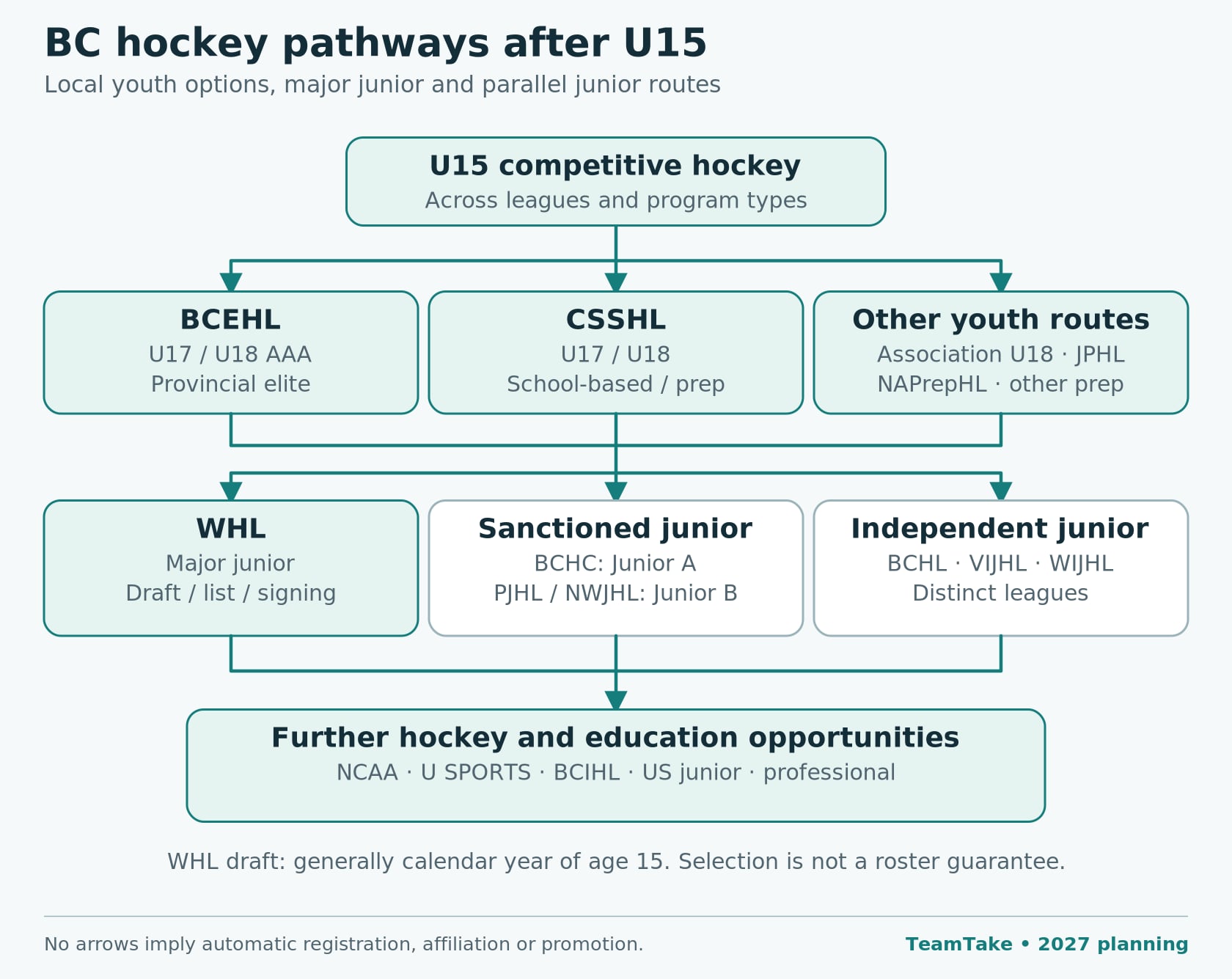
Figure 1. Possible BC development routes, not a mandatory progression. Affiliation, player rights, transfers and independent-league registration must be checked before moving between teams.
1. What comes after competitive U15 hockey in British Columbia?
For most competitive BC players, the immediate decision is not WHL versus NCAA. It is where to play during the next one to three seasons.
| Pathway | Typical next level | Why consider it | What to investigate |
|---|---|---|---|
| BCEHL | U17 AAA and U18 AAA | Sanctioned provincial elite competition; familiar Western Canadian scouting route | Draw eligibility, roster role, schedule, affiliation and goalie support |
| CSSHL | U17, U17 Prep, U18 Prep | Education-linked academy model; regular competition and showcase opportunities | Exact division, actual games, academics, travel, fees and advancement |
| Local association / winter club | U18 A1, AA or local equivalent | Can offer meaningful minutes, school continuity and lower travel burden | Actual opposition, coaching, individual development and links to junior teams |
| JPHL | U17 AAA, U18 AAA and other league-specific divisions | Hub-based academy competition and showcases | Eligible birth years, actual roster role, travel, registration and advancement |
| NAPrepHL | 16U, older divisions where offered | Growing BC prep/showcase option; local games and interregional events | Confirm 2027–28 division, tier, games, opponents, travel, school arrangements and verified outcomes |
| Other independent academies and leagues | U16, U17, U18 or equivalent | Additional development models and competition schedules | Sanctioning, insurance, strength of opponents, transfers and independently verified outcomes |
| US AAA or prep school | 15O, 16U, 18U, school hockey | Alternative recruiting markets; sometimes a suitable educational opportunity | Admission, immigration status, tuition, housing, player role and eligibility |
The BCEHL operates U15, U17, U18 and women's U18 AAA divisions. The CSSHL offers multiple age and competition divisions, including U17 and U18 Prep. A club's name alone does not tell you the strength of its schedule or whether the athlete is in the highest division.
AAA and Prep are not mutually exclusive: AAA describes a competitive classification, while Prep may describe a school-linked program or a named division. For more on these labels, see What Does AAA Actually Mean in Youth Hockey?.
A strong U17 role may be a better bridge to U18 than a marginal U18 role. Conversely, an unusually advanced player may benefit from competing against older athletes. The decision should be based on readiness and the development plan, not merely playing up.
JPHL and NAPrepHL: additional academy routes
The Junior Prospects Hockey League (JPHL) operates a hub-based model with showcase events. Its published divisional layout includes U17 and U18 AAA, and its league site describes a player-transfer agreement with the BCHL. Neither a transfer agreement nor a showcase guarantees a junior roster place; confirm the applicable player rights and transfer conditions for 2027–28.
The North American Prep Hockey League (NAPrepHL) is another youth/prep competition with an expanding presence in BC. The league announced Sharpshooter Academy in Langley for 2025–26 and Abbotsford Venom HC for 2026–27. Vancouver Whales Hockey Club lists its 14U and 16U teams and reports local games against Sharpshooters, Abbotsford Venom HC and Fraser Valley Aces. This demonstrates local competition, not a confirmed 2027–28 lineup. The league also lists interregional showcase events.
For a player finishing competitive U15, 16U may be an option; older divisions depend on the league and the individual academy. Verify birth-year eligibility (14U/16U labels need not match Hockey Canada U15/U18), tier, actual number of competitive games, roster size, goalie rotation, school support, travel and costs. NAPrepHL is not the US North American Prospects Hockey League (also abbreviated NAPHL) and is not the NAHL junior league. Do not assume that playing in NAPrepHL carries the same registration, scouting or affiliation arrangements as BCEHL, CSSHL or JPHL. Ask the relevant registrar directly.
This is a developing route in BC; it would be premature to claim a league-wide rate of advancement to major junior, Junior A or college hockey. Ask for recent player destinations by birth year and position, including the players who did not advance. For the earlier age groups, see BC Youth Hockey Pathways: From U13 to U15 AAA and Beyond.
Is elite U15 hockey a prerequisite for junior hockey?
Usually a competitive advantage, not a formal requirement. Strong AAA teams and elite academy or school-based programs are common scouting environments. Players learn to execute at higher speed and against stronger opponents. Those advantages matter, particularly for early major-junior recruitment.
The 2026 WHL draft provides useful evidence. The CSSHL reported that 85 current and four former players were selected. Players from provincial AAA programs were also prominent, and the official draft results included players from U15 AA. See the CSSHL's 2026 draft report and the WHL's first-round report.
That demonstrates where many early prospects play. It does not demonstrate that purchasing an academy place causes a draft selection, or that an AA player has no chance. These teams recruit already talented players, and their visibility differs. Draft counts also say nothing about the chances of an individual player without knowing the number of eligible athletes.
By U17 or U18, a player targeting high-end junior hockey will generally need to show that they can perform against credible elite opposition. If they are currently below that level, the practical next goal is to close that gap, earn a suitable role and accumulate evidence of performance. A later move to AAA, prep or junior B remains possible.
What scouts can evaluate: skating and pace; decisions under pressure; puck skills; positional execution; consistency; competitiveness; coachability; physical readiness; and, for goaltenders, tracking, movement, reads, rebound management and recovery. A label or highlight reel cannot substitute for repeated game performance.
2. The WHL draft and major-junior opportunity
What selection means for a BC family
In the regular Western Canadian pathway, the WHL Prospects Draft occurs in the calendar year of a player's 15th birthday, typically after their final U15 season. For families planning the next two drafts, the established age pattern points to 2012-born players in spring 2027 and 2013-born players in spring 2028. The last completed draft (2026) covered the 2011 birth cohort. Confirm the league’s eligibility and dates for the relevant year.
A draft selection gives a club the opportunity to hold the player's WHL rights. It does not mean that a 15-year-old immediately leaves school, receives a signed player agreement or has a guaranteed roster position. Many prospects return to U17/U18 or prep, and some later enter Junior A.
An undrafted eligible player may subsequently be added to a WHL club's protected list. Players can also progress through other junior leagues. The WHL's draft explanation describes this post-draft listing process.
| Term | What it means | What it does not mean |
|---|---|---|
| Scouted | A team has observed or evaluated the player | The player has been offered a spot |
| Drafted / listed | A club holds or acquires league-specific player rights | A guaranteed contract or playing time |
| Camp invitation | A team wants to evaluate the player, or offers an open evaluation opportunity | A roster offer |
| Signed player agreement | Contractual relationship with specified obligations and benefits | A guaranteed starting role or permanent roster spot |
| Affiliated / AP | Eligible to appear with a higher team under applicable rules | Unlimited ability to move between teams |
At 15 or 16, families should ask about the rules governing underage games, affiliation, school arrangements and possible return to minor hockey. Do not extrapolate last season's game limits to a new season without confirmation.
Education and finances in the WHL
The WHL Scholarship generally awards a year of post-secondary support for each eligible season played, with tuition, compulsory fees and textbooks covered according to the agreement. The amount is benchmarked to an eligible publicly funded institution; it is not necessarily the full price of any US private university. Conditions, claim deadlines and interactions with other scholarships matter.
A WHL Standard Player Agreement describes club-provided support such as housing, equipment, insurance and educational benefits. Major junior normally is not a tuition-based youth academy. Families should nevertheless review actual coverage and any personal expenses, and obtain written advice on NCAA amateurism before accepting benefits or signing agreements.
3. BC junior hockey: what to know for 2027
BC's junior landscape has changed substantially since the BCHL departed Hockey Canada in 2023. The most important distinction for parents is the current league and sanctioning status of a specific team, not what that team was called several years ago.
| League | Latest confirmed status (2026–27)* | Typical development objective |
|---|---|---|
| WHL | CHL major junior | Major-junior competition, NHL scouting, university options |
| BCHL — BC Hockey League | Independent, high-level junior | College recruitment, development and professional scouting |
| BCHC — BC Hockey Conference | Hockey Canada / BC Hockey-sanctioned Junior A | Progression to WHL, post-secondary hockey and national Junior A competition pathway |
| PJHL — Pacific Junior Hockey League | Sanctioned Junior B in the Lower Mainland | Local competitive junior, potential promotion to Junior A |
| VIJHL — Vancouver Island Junior Hockey League | Independent junior; BCHL partner | Local junior development and opportunities to advance |
| WIJHL — Western International Junior Hockey League | Independent junior; launched in 2026 | Regional junior development and possible advancement |
| NWJHL — North West Junior Hockey League | Sanctioned Junior B; includes two northern BC clubs | Regional junior hockey and possible advancement |
*Use this as the starting point for 2027–28 planning; verify league membership and rules for the new season. BCHL and BCHC are separate organizations.
Source: BC Hockey's April 21, 2026 junior pathway update, BCHC's league overview, and BCHL–VIJHL partnership announcement.
BCHL: a long-established college development route
The BCHL has recruited extensively for the NCAA for decades and continues to do so after the CHL eligibility change. Teams recruit players directly rather than using a league-wide entry draft. A family can approach teams about evaluation, but team selection and roster competition remain significant.
The league's prospect information describes its recruitment approach and roster structure; its 2026–27 NCAA alumni list provides a useful way to investigate actual university destinations.
It is important to distinguish the league's self-description as a high-level or Tier I college-track league from the formal USA Hockey Tier I designation (which applies to the USHL). The labels are not interchangeable.
The BCHL's independence gives it a different operating framework, but also means it does not participate in the Hockey Canada Junior A championship structure. Moving into or out of the sanctioned system requires advance attention to registration rules.
BCHC: BC's newly organized sanctioned Junior A route
The BCHC began its inaugural season in 2026–27 with 22 founding teams announced by BC Hockey: 14 previously in the KIJHL and eight previously in the PJHL. Examples in the Lower Mainland include the Burnaby Steelers, Delta Ice Hawks, Langley Trappers, Port Coquitlam Trailblazers, Richmond Sockeyes and Ridge Meadows Flames. Interior examples include Nelson, Revelstoke, Kimberley and Quesnel.
The league operates under the Western Canadian Development Model alongside the WHL and other Western Canadian Junior A leagues. It was established to restore a sanctioned BC route toward the Centennial Cup. The BCHC describes the Centennial Cup as its intended national championship route; confirm the current qualification and membership arrangements before assuming a team is eligible.
The old assumption that all KIJHL or PJHL clubs have the same Junior A designation is no longer reliable. Several teams moved to the BCHC, while eight former KIJHL clubs founded the independent Western International Junior Hockey League (WIJHL), which began operating in 2026. Its founding clubs include Castlegar, Chase, Kelowna and Spokane. See the WIJHL information hub. Check where any particular former member operates today. Examples of clubs in the PJHL’s 2026–27 lineup include Port Moody, North Vancouver, Cloverdale and White Rock. The VIJHL remains independent and its partnership with the BCHL has been extended, with enhanced management arrangements beginning in 2027–28.
The BCHC–PJHL development partnership is particularly relevant to younger junior candidates. A good Junior B role can provide a foundation for moving up; it is not a guarantee of promotion.
Sanctioned versus independent: does it matter?
Yes, but not as a simple judgment of player quality. Sanctioning affects registration, affiliation, disciplinary oversight, insurance, complaint channels, representative programs and movement between leagues. NCAA amateurism and academic eligibility are separate questions.
Before joining an independent team, obtain written answers about return-to-sanctioned-hockey restrictions, release conditions, insurance, safeguarding, and how disputes are handled. Check the governing body's current dates and exceptions rather than assuming a player can move freely during the season. See BC Hockey's explanation of non-sanctioned hockey.
4. Practical recruiting and season planning in BC
| Stage | Main decision | What to do |
|---|---|---|
| Final U15 winter | U17/U18 versus prep | Confirm draw eligibility, team needs, tryout registration, school arrangements and coach references |
| U15 spring and summer | WHL draft, camps and next-season offers | Understand draft rights; ask whether camp invitations are open evaluations or specific recruitment interest |
| Age 15–16 | Earn a meaningful youth role | Track actual games, development feedback and affiliate opportunities; maintain school credits |
| Age 16–17 | Consider concrete junior options | Compare junior roster roles with U18; ask about billet arrangements, injury support and return rights |
| Age 17–19 | Junior, graduation and college planning | Contact appropriate college programs; check NCAA clock, admissions, funding and entry dates |
Do not treat a WHL camp invitation, a BCHL identification camp, a BCHC evaluation or an academy offer as interchangeable. Some camps are paid open registrations; others are genuine team-specific evaluations. Before paying, ask whether the team is recruiting at the athlete's position, how many players are already signed, what evaluation is provided, and what happens if the athlete is not offered a place.
Compare actual options, not labels
| Factor | Elite U17/U18 hockey | Junior A / independent junior | Junior B |
|---|---|---|---|
| Typical benefit | Age-group competition and structured development | Older opponents and exposure to junior recruiting | Potentially more meaningful game role and local continuity |
| Potential downside | Tuition, travel or reduced minutes | Limited minutes, school/billet transition, roster uncertainty | Strength of opposition and exposure vary |
| What to verify | Division, games, school, coaching and roster depth | Written role, cost, registration, release and affiliation | Coaching, actual advancement, affiliation and school compatibility |
A 15-year-old who needs to improve their skating or puck skills may benefit from another year of high-quality age-group competition. A physically ready 17-year-old with genuine junior interest may benefit from a move. Ask what a good season would look like in measurable development terms, not only which team the player could join next.
5. Goalies: the decision is often about starts
Goaltenders need game reads, recovery after goals, traffic management, puck tracking and technical feedback. A higher league can offer faster shots and practice quality, but a second or third goalie may receive limited starts. Before moving into junior, ask about returning goalies, signed prospects, age mix, rotation, affiliate games, specific goalie coaches and the team's recent actual distribution of starts.
A useful scenario: a 16-year-old goalie is offered a Junior A backup role with an estimated 8–12 starts, or a strong elite U18 role with 22–28. Those figures are illustrative, not targets. The junior role may make sense if the development and affiliation plan is excellent. The U18 role may make more sense if the player needs repeated game exposure. Avoid accepting a verbal rotation promise without understanding how the organization handled its goalies last season.
Historical College Hockey Inc. research found that roughly 60% of the 201 men's NCAA DI goalies studied from 2023–24 were still in youth, prep or high school hockey at age 17. That describes a historical successful cohort, not an individual probability. It predates the CHL/NCAA changes. The new DI age-based model means delaying college entry can now cost eligibility, so plan the junior and university timetable together.
6. Where can BC junior hockey lead?
| Destination | What families need to know |
|---|---|
| WHL | Major-junior recruitment and NHL scouting; draft/list rights and signings are distinct |
| NCAA Division I or III | College coach recruitment, academic admission, eligibility and written aid; CHL participation is no longer an automatic DI barrier |
| U SPORTS / BCIHL / ACAC | Canadian post-secondary hockey, with differing academic and roster requirements |
| USHL / NAHL and other US junior | An alternative junior route, subject to recruitment, transfer, immigration and roster rules |
| NHL / AHL / ECHL or overseas | Professional contracts for a small minority; professional terms may affect collegiate eligibility |
For first-time full-time college entrants from fall 2027, the NCAA DI age-based rule generally begins a five-year period at initial full-time college enrollment or the qualifying academic term after the athlete turns 19, whichever comes first. For a spring-born athlete who delays college entry until 20 or 21, the available period may shrink to four or three years. This is not the same as a guarantee of seasons played. See NCAA eligibility guidance and the national TeamTake guide for the detailed example and other college options.
7. Costs, schooling, billets and transfers
Get a full written quote: academy or player fees, school tuition, billeting, travel, equipment, food, insurance, camps and refund conditions. Major-junior benefits are not the same as independent junior or academy arrangements. Do not compare sticker prices alone. Ask which expenses are covered, when payment is due and what happens if a player is released, traded or injured.
When billeting is involved, check host screening, safeguarding policies, accommodation and meals, transportation, supervision, emergency contact, school attendance, confidential complaints and the process for changing homes. Include the athlete in the decision. A younger player should not be left to negotiate serious safety or housing concerns alone.
Before moving between independent and sanctioned systems, ask both the current and receiving organizations to confirm registration, eligibility, release and affiliation in writing. Refer to BC Hockey's non-sanctioned hockey guidance. Policies may change between seasons.
For families in Metro Vancouver or the Fraser Valley, a program that adds several hours of daily transportation may make school, sleep and recovery difficult even if the ice schedule looks attractive. Interior and northern families face different distance and billet decisions. Consider the complete weekly schedule and time away from home, not just the number of ice sessions.
8. A decision checklist before accepting a roster spot
If you are preparing for spring 2027 evaluations, see BC Hockey Tryouts: What to Do Before the Official Camp for a practical checklist on contacting programs and preparing before the official camp.
- What role is genuinely available, and how many players are competing for it?
- What were last season's actual games, starts, roster departures and next destinations?
- What is the individual development plan, and who provides feedback?
- Are there legitimate affiliate opportunities, and what are their limits?
- What are the academic, transportation and billet arrangements?
- What are the full costs, refunds, injury provisions and release conditions?
- How does the choice affect participation in another league or future college eligibility?
Ask several current and former families, not only those whose children progressed. A strong program can explain what happened to players who did not advance, not just list its successful alumni.
Keep the next decision in perspective
BC has multiple credible paths after U15. The WHL draft is an important milestone for some athletes, not a final verdict. A good U17 or U18 season, a well-chosen local junior opportunity and a realistic education plan can keep options open as a player develops.
For a detailed comparison of Canadian and US junior leagues, NCAA eligibility, post-secondary hockey and professional opportunities, read Hockey Beyond U15: A Canadian Guide to Junior, College and Professional Pathways.
Join the conversation on TeamTake
Which BC route did your family choose? What did you learn about tryouts, development, junior recruitment or the transition to living away from home? Share experiences in TeamTake discussions, without identifying individual minors.
Sources and editorial notes
TeamTake Editorial — 2027 planning edition; information reviewed November 24, 2026. The guide uses the current BC Hockey and league announcements, with links beside relevant claims. League names, roster limits, eligibility, fees and affiliation policies change; confirm with the organization before committing. The diagrams represent possible routes, not automatic transfers or league rankings. The national guide, Hockey Beyond U15: A Canadian Guide to Junior, College and Professional Pathways, contains broader academic and eligibility sources.
Comments
Be the first to comment.