TeamTake editorial
The Other Game Being Played in the Stands
Published
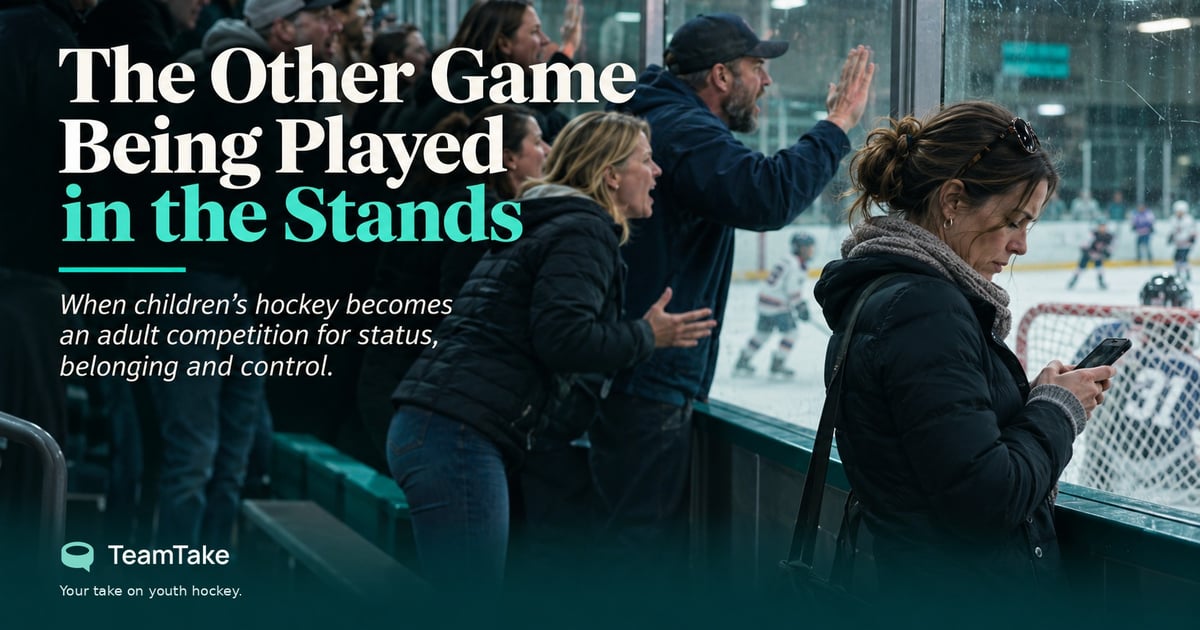
When children's hockey becomes an adult competition for status, belonging and control.
The game is getting close.
A few parents are getting increasingly animated. Someone bangs on the glass. Someone yells at the referee. Another parent starts shouting instructions to the players.
You were enjoying the game a few minutes ago. Now every shift seems to carry a little more weight. You find yourself hoping your child won't be on the ice at the wrong moment.
And then it happens.
Your kid makes a mistake. A missed pass, a lost puck, a save that should have been made. The puck ends up in your team's net.
You hear a groan, perhaps a loud comment. Someone throws their hands up. A parent exchanges a look with another parent. Nobody necessarily says anything directly to you, but you know they know whose child it was.
You look down at your phone, suddenly finding something very interesting on the screen.
You haven't played a single shift. You haven't touched the puck. You haven't made a mistake. Yet somehow, you're the one feeling ashamed.
And the strangest part? This is supposed to be your Saturday morning entertainment.
The pressure was there before the goal
Think of a hockey stick flexing before a shot. Energy builds up as the shaft bends, waiting to be released.
Something similar can happen in the stands. The banging on the glass, the complaints about officiating, the increasingly frantic instructions and the frustration with missed chances all raise the emotional stakes. Each reaction makes the next one feel a little more acceptable.
For a while, that energy has no particular destination. Then a child makes a mistake, and suddenly there is somewhere for it to go.
The mistake didn't create the problem. It gave the problem a target.
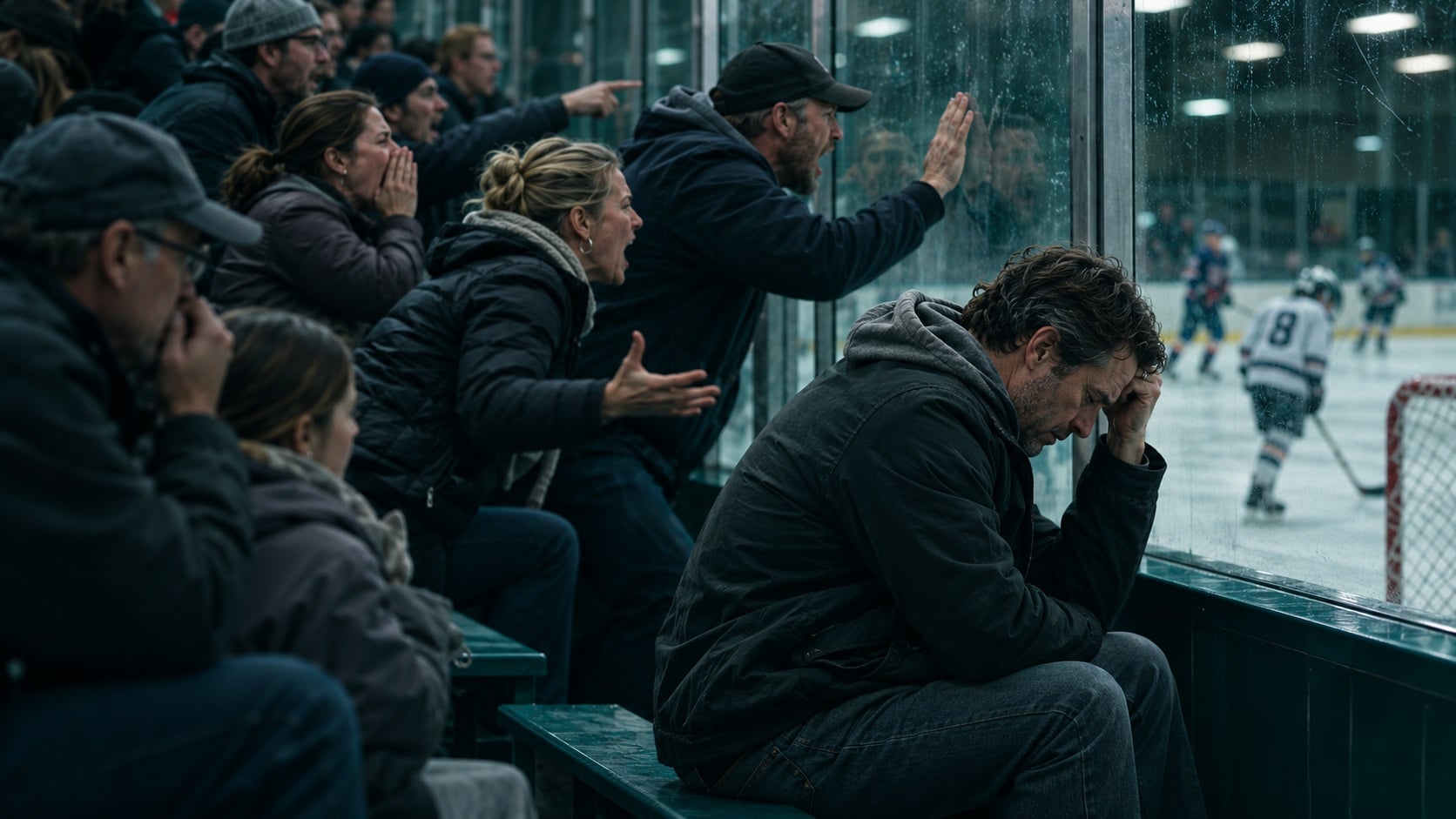
The player on the ice has made a perfectly ordinary hockey mistake. The adults, however, have created an environment where that mistake can feel like a public failure for an entire family.
This can happen without a single parent explicitly blaming another. A few gestures, a muttered remark and a change in the atmosphere can be enough. Of course, not every groan is directed at a particular player, and we can't always know what other people are thinking. But when criticism of individual children becomes a pattern, families can learn to anticipate it.
Eventually, you may find yourself hoping for something rather different from a team victory. You just hope your child gets through the game without becoming the subject of the conversation.
The parent who can't win
What exactly are you supposed to do in that moment?
You could stay quiet. Perhaps that's the safest immediate response. But it can feel as though you're accepting the idea that your child has let everyone down, and that you owe the group some kind of apology.
You could try to lighten the mood. “Come on, it's just a game.” But someone might remind you that this is competitive hockey, that the kids need to learn accountability, or that perhaps your family isn't taking it seriously enough.
You could defend your child. Now you risk becoming the parent who makes excuses for their kid.
You could confront the people who have been yelling. If the conversation escalates, you might become the one accused of creating drama. The behaviour that started it can get lost in the argument about your reaction to it.
None of those outcomes is inevitable. But if you've spent enough weekends with a particular group of parents, you may already have a pretty good idea of which conversations are likely to go well and which aren't.
The most frustrating part is that you've been drawn into a competition you never agreed to enter. Your child's performance has become connected to your standing among other adults.
Your child's mistake is not your social failure.
There's nothing wrong with expecting effort and accountability from young athletes. But learning from a mistake is the player's responsibility, with guidance from the coach. It isn't a debt their parents owe to the people in the stands.
When passion becomes a social currency
Hockey is emotional. That's part of what makes it such a wonderful sport to play and watch. A spectacular save, an overtime winner or a hard-fought comeback can bring a whole group of strangers together.
The trouble begins when displaying that emotion becomes a way of establishing how much you care, or how much authority you have within the group.
The loudest parents can start to set the tone. Their reactions tell everyone else what counts as a good play, a bad mistake, an unacceptable call or a disappointing performance. Other parents may join in, not necessarily because they agree with everything being said, but because it feels natural to participate in the group's excitement.
Before long, the quiet parent who doesn't get involved can appear less invested than the person banging on the glass. Never mind that the quiet parent also gets up at five in the morning, drives across town for practice, pays the fees and supports their child through the difficult days.
Research offers some insight into these dynamics. A 2023 study, Rage at the Rink: Parental Aggression in Quebec Minor Hockey, examined how factors including expectations of success, the cost of participation, rivalries, spectator conduct and the surrounding social environment can interact to produce aggression.
A 2008 study of youth soccer spectators also found links between parents' motivational orientation, threats to their sense of self, feelings of pressure, and anger or aggressive behaviour. When a child's sporting experience becomes closely tied to a parent's own ego, disappointment can become surprisingly personal.
And a 2026 study of social norms in US youth sports examined how parents' perceptions of what other spectators do and approve of relate to their own behaviour. That's a useful reminder that the atmosphere in the stands is something we create together.
These studies don't tell us what every individual parent is thinking, and they don't establish how often the particular scenario described here occurs. But they help explain why spectator behaviour is about more than a few individuals losing their temper.
A loud minority doesn't have to represent the majority to influence the experience of everyone around them.
The self-appointed coaches in the stands
Sometimes the other game continues long after the whistle.
You're standing in the lobby waiting for your child when another parent approaches you.
“Your son really needs to move the puck quicker.”
“Your goalie should come out further on those shots.”
“Your daughter has to be more aggressive in the corners.”
And sometimes it isn't even presented as advice. A parent approaches you and says, “You! Tell your kid to pass the puck!” or “Tell your kid to start covering their player!”
Notice the difference. You're no longer being offered an opinion. You're being given an instruction, as though another parent has the authority to tell you what to tell your child. Suddenly, you're expected to carry someone else's frustration from the stands into the car ride home.
Perhaps the advice is genuinely intended to help. Parents can learn a great deal from each other, particularly when they have built a friendship and welcome each other's perspective.
But there is a difference between sharing experience when someone asks and appointing yourself as the evaluator of another person's child.

The conversation can subtly place one parent in the role of an expert and the other in the role of someone expected to receive correction. You might feel obliged to explain what your child has been working on, defend a decision the coach made or acknowledge a supposed weakness just to keep things friendly.
What makes this particularly awkward is that you may need to see this person three or four times a week. You want your children to enjoy being teammates. You don't want a disagreement about skating technique to become an ongoing tension between families.
It's perfectly reasonable to say, “Thanks, but we leave the coaching to the coaches.” Or, more simply, “Thanks, but we're not looking for coaching advice.”
Of course, the other parent might respond, “But our coaches are terrible. They don't care, they can't teach, and I know better!”
Maybe they do have legitimate concerns about the coaching. Maybe they even have more hockey experience than the coach. But neither gives them the authority to direct another family. You don't have to defend the coaches to defend your own boundaries. A simple “That's a separate issue. I'd rather not discuss my child's performance” is enough.
You don't have to demonstrate your own hockey knowledge, offer a counter-critique of their child or explain why their assessment is wrong. You can simply decline the conversation.
The quiet spot behind the net
Look around an arena and you may notice a parent standing alone behind the goal, away from the main spectator group.
For a goalie parent, that's often just the best place to watch the game. From there, you can see angles, positioning and movement that are harder to appreciate from the stands.
For some parents, however, the distance offers something else: peace.
There is no need to listen to a running commentary about every goal against. No need to decide how to respond to someone criticizing your child. No need to manage your facial expression after a difficult save or a mistake.
It can be a relief to watch hockey again rather than watch the people watching hockey.
But there can be a cost to that distance.
After the game, parents gather in the lobby. Someone suggests getting lunch. Someone starts discussing next weekend's tournament. Friendships are formed through these small, repeated interactions, not just through official team events.
When you regularly remove yourself from the group, you may also miss the good parts of being a hockey parent. You can be relieved to have avoided an uncomfortable morning and still feel a little lonely when you see everyone else laughing together afterward.
Withdrawal isn't necessarily a sign of indifference or a lack of social skills. Sometimes it's a reasonable response to an environment that has become exhausting. And taking a break from the stands doesn't mean you have to give up on connecting with the families you enjoy spending time with.
Nobody should have to choose between peace of mind and belonging to their child's hockey community.
When you're already on the outside
Imagine joining a hockey team where some of the families have known each other for years. They played together growing up, understand the local hockey landscape and already have relationships with coaches and other parents.
Now imagine being the family that has just moved to the area, the first in your family to play hockey, or the parent who is still getting comfortable speaking English or French.
The unwritten rules are harder to read. You may not know whether a comment is a joke, an accepted part of the culture or something you are entitled to challenge. You might hesitate to disagree because you're still trying to find your place in the community.
For families who already experience prejudice or exclusion, the social stakes of a confrontation may feel even higher. The Quebec study mentioned earlier identifies racism, xenophobia and antagonism around identity as broader factors that can contribute to parental aggression in minor hockey.
That doesn't mean established hockey families are inherently unwelcoming. Many are the first to help a newcomer figure out equipment, explain a rule or offer a ride to practice. Those small acts of generosity make an enormous difference.
It does mean we should pay attention to who feels comfortable in the community, not just to who appears to be enjoying themselves the most.
A family shouldn't have to adopt the habits of the loudest people in the stands to earn a place in the group.
Competitive doesn't mean hostile
There is a familiar response to concerns about spectator behaviour: “If you can't handle it, maybe competitive hockey isn't for you.”
But what exactly is a child supposed to learn from watching adults blame other people's children?
Competitive sport requires composure under pressure. A player needs to recover from a bad shift. A goalie needs to reset after a goal. A team needs to stay focused when an official makes a call it disagrees with.
We admire athletes who can do those things. Why would we expect anything less of ourselves in the stands?
You can care deeply about winning without treating the opposition as enemies. You can be disappointed by a mistake without turning it into a personal judgment. You can support a demanding coach and a high-performance program without criticizing children from behind the glass.
And you can celebrate with all the enthusiasm in the world when your team scores.
Being calm isn't the opposite of being competitive. Composure is one of the qualities that good competitors develop.
Finding the right words
The difficulty with uncomfortable interactions at the rink is that they rarely give you time to prepare a thoughtful response. You may only think of the right thing to say hours later, when you're replaying the conversation in your head.
Having a few simple phrases in mind can help you maintain your boundaries without escalating the situation. You don't need to deliver them perfectly or use them every time. Sometimes choosing not to engage is the better option.
| Situation | What you could say |
|---|---|
| Another parent blames your child for a goal. | “Mistakes happen. That's part of hockey.” |
| A parent offers unsolicited coaching advice. | “Thanks, but we're not looking for coaching advice.” |
| Someone demands, “You! Tell your kid to…” | “Please don't tell me what to say to my child.” |
| They argue that the coaches are incompetent and they know better. | “That's a separate issue. I'd rather not discuss my child's performance.” |
| They persist with their advice. | “I've already said I'd rather not discuss this.” |
| Someone suggests your child isn't good enough. | “They're here to learn and develop, just like everyone else.” |
| Someone questions your competitive spirit. | “I care about winning too. I just don't think blaming kids helps.” |
| Someone tells you competitive hockey isn't for you. | “I think competitiveness and respect can coexist.” |
| Parents start criticizing another person's child. | “I'm sure that kid is doing their best out there.” |
| Someone expects you to join in criticizing the team. | “I'd rather just enjoy the game.” |
| Someone asks why you're watching separately. | “I enjoy watching from here. It's a little more peaceful.” |
| Someone becomes personally confrontational. | “I'm here to watch hockey, not to argue.” |
| Another parent makes a disrespectful comment about your child. | “I'd appreciate it if you didn't speak about my child that way.” |
| A disrespectful comment is disguised as a joke. | “I don't find that particularly funny.” |
The goal isn't to win the argument. It's to decline the invitation to participate in it.
A few principles can help:
- Don't overexplain. You don't have to justify a reasonable boundary or prove your understanding of hockey.
- Don't counterattack. Criticizing the other parent's child only reinforces the culture you're trying to change.
- Don't apologize for your child's ordinary sporting mistakes. Making mistakes is part of learning, and your child doesn't owe the stands a flawless performance.
If someone refuses to respect your boundary, you're entitled to end the conversation. You don't have to keep defending your position until the other person agrees with you. And if an interaction feels unsafe, you can leave without saying anything at all.
Being calm doesn't mean accepting disrespect. Nor is it your responsibility to manage everyone else's emotions at the rink.
Making the stands a place we all want to be
No one needs to deliver a speech to the entire spectator group. Changing the atmosphere can start with much smaller choices.
If a parent starts blaming a player, a simple “They'll get the next one” can redirect the conversation without starting an argument. If the group is getting increasingly heated, you can choose not to add to it. Cheer for a good defensive effort or a player who gets back into the play after a mistake, not just the children scoring the goals.
If another parent offers unwanted criticism of your child, set a brief boundary. If you need some space, take it. You are not obligated to resolve a heated situation on the spot. Repeated harassment, discriminatory remarks or threatening conduct warrant a different response: document what happened and use the appropriate team, association or arena reporting process. Leave an unsafe situation rather than trying to match someone's aggression.
And if you're one of the parents who feels at home in the group, notice the people who don't. Invite the quiet parent to join you for coffee. Ask a newcomer how their child is enjoying the season. Make it clear through your actions that a family's place on the team doesn't depend on how their child played that morning.
Team managers and associations can help, too. Clear spectator expectations, consistent responses to misconduct and an accessible way to raise concerns can make it easier for parents to uphold those expectations together instead of leaving each family to negotiate its own boundaries.
Sometimes the first step is discovering that the other quiet parents feel much the same way you do. That's one of the reasons we created TeamTake, a place where hockey parents can connect and discuss their experiences, including in anonymous discussions with verified members of their hockey community.
There is only one game that needs to be played
The puck is going to end up in the wrong net again. Someone will miss an assignment. A child will have a difficult game, and another child will have the best game of their season.
That's hockey.
What happens in the stands is up to us.
Imagine being able to watch your child make a mistake without feeling the need to look down. Imagine hearing the parent next to you say, “Come on, kid, you've got this.” Imagine knowing that you'll still be welcome in the lobby afterward, whatever the final score.
That's the kind of hockey community worth building.
Our children came to the rink to compete against another team, not to determine their parents' place in a social hierarchy.
We came to watch them play.
Let's enjoy the game.
Research and further reading
- Rage at the Rink: Parental Aggression in Quebec Minor Hockey (2023), Journal of Emerging Sport Studies.
- Determinants of Parents' Sideline-Rage Emotions and Behaviors at Youth Soccer Games (2008), Journal of Applied Social Psychology.
- What Parent Behaviors Are the Norms at Youth Sport Events in the US? Perceptions of Sport Parent Sideline Behaviors and Social Norms (2026), Psychology of Sport and Exercise.
The opening and other rink-side scenes are illustrative scenarios, not accounts of specific identifiable families. Images are AI-generated editorial illustrations.
KindDolphin244
Our son plays goal and I caught myself apologizing to another parent after a loss last season. Actually said sorry, like I'd let the puck in myself. My husband asked why I was doing that and I couldn't give him a decent answer, other than knowing we'd hear about it all week.
KindFrog429
In reply to KindDolphin244
goalie parent too, the apology thing is painfully familiar. Meanwhile nobody expects the forwards parents to explain the 12 shots they put straight into the other goalie's chest lol
KindWren946
Apparently paying team fees also gets you 14 assistant coaches in the lobby.
CleverSquirrel271
I'll admit I've been the parent throwing their hands up, usually at a missed pass because I'm convinced I can see the obvious play from the stands. Then my daughter asked why I looked so mad during her games, she thought I was mad at her. I wasn't trying to pick on anyone, but she couldn't know that from the bench. I'm trying to catch myself now, and I've stopped discussing individual kids with the other parents. Easier some weekends than others.