TeamTake editorial
When a Hockey Coach Becomes the Reason a Kid Quits
Published
It takes years to build a child's love for hockey. How quickly can an adult take it away?
Remember when your child couldn't wait to get to the rink? When the hockey bag was packed before dinner, the stick was never far from reach, and the biggest disappointment of the week was a cancelled practice?
Then something changes. On the drive to the rink, they're unusually quiet. After practice, you ask how it went and get a shrug. Eventually, they tell you they don't want to play anymore.
It's tempting to assume they've lost interest, discovered another hobby or reached the point where hockey is becoming too demanding. All of those things happen, and there's nothing wrong with a child deciding that hockey is no longer for them.
But sometimes the child still loves the game. They just can't stand going to practice anymore.
Sometimes a kid doesn't quit hockey. They quit the environment in which they're playing it.
Before we tell a young athlete to persevere, it's worth finding out what we're asking them to persevere through.
The adult whose words carry more weight than they realize
A coach can have an extraordinary influence on a young player's life. They decide who plays, who gets opportunities, how mistakes are handled and, to a considerable extent, how a child feels about their place on the team.
A simple comment from a respected coach can make a child's entire week. A dismissive comment can stay with them long after the adult has forgotten saying it.
Consider a player who hears nothing when they do something well, but gets called out in front of teammates whenever they make a mistake. Or one who is repeatedly told they aren't good enough, without being given any useful explanation of how to improve. Perhaps they're the player everyone knows will be benched first, regardless of what happens on the ice.
None of this means children need constant praise. A coach should be able to tell a player that their effort, technique or decision-making needs work. Honest feedback is essential. But criticism that gives a child something to work on is very different from criticism that leaves them questioning whether they belong.
This matters beyond the next game. A systematic review of prospective studies of adolescent team-sport dropout identified motivation and enjoyment as important factors associated with staying in sport. A 2024 prospective study of 7,110 young athletes in five sports also linked supportive, learning-oriented coaching climates with continued participation and controlling, ego-oriented climates with dropout.
These findings don't establish why any particular hockey player quits. But they give us good reason to take the environment seriously rather than assuming the child simply lacks commitment.
“It's AAA. What did you expect?”
There is a particular version of this conversation that happens in competitive hockey.
A parent raises a concern about the way players are being treated, and the response is that this is AAA. It's not house hockey. Your child needs to toughen up. If they can't handle this, how will they ever survive junior hockey?
Higher levels of hockey are supposed to be demanding. Players should expect faster competition, harder training, more detailed feedback and a greater responsibility for their preparation. Not everyone will receive the same opportunities, and coaches will sometimes have difficult decisions to make.
That is not the same as giving adults permission to lose control of their emotions.
It's AAA. That's not an excuse.
Moving to a higher level should raise the standard of coaching, not lower the standard of acceptable behaviour.
Some families find that the higher they climb, the more dependent they become on a small number of coaches, directors or academy owners. A recommendation or roster decision may matter enormously to the child. The fear of losing a hard-earned spot can make parents and players reluctant to question behaviour they would not accept elsewhere.
That doesn't mean AAA coaches are inherently worse than recreational coaches. Many are excellent educators with a remarkable ability to combine demanding standards with genuine care for their athletes. Nor is a child's frustration with a demanding coach necessarily evidence of mistreatment.
The point is that the level of hockey should never be used to end a conversation about how an adult is treating children. A coach who works with ambitious athletes has more responsibility to manage the pressure appropriately, not less.
Whose success are we measuring?
Coaches have ambitions of their own. Some want to progress to a higher coaching level. Some need to demonstrate results to parents, directors or the owners of a commercial hockey program. Most would rather win than lose, and there is nothing inherently wrong with that.
The problem arises when the easiest way to demonstrate success as a coach conflicts with the work of developing young players.
A tournament trophy is visible. So is a league ranking. A child who has become more confident, developed better habits or learned to make decisions under pressure may be harder to measure. The benefits of giving an inexperienced player meaningful opportunities today might not become obvious until next season.
If the coach's reputation depends on winning this weekend, there is an incentive to shorten the bench, lean on the strongest players and limit opportunities for those who are still developing. Sometimes that's a legitimate competitive decision. When it becomes the default approach throughout a season, it's worth asking what the rest of the roster is there to learn.
Parents are part of this equation too. Winning feels good. The group chat lights up, the medals come home, and the championship photo goes on Facebook. After a loss, a different set of emotions takes over. It is possible to become so invested in that emotional reward cycle that we start evaluating the quality of a coach almost entirely through the scoreboard.
Imagine a coach who wins a tournament while several children spend most of it watching. The parents of the leading players may consider the weekend an outstanding success. The parents of the children who hardly played may have a different perspective. Both paid for a hockey experience.
A competitive team is not obliged to distribute every shift equally in every situation. But a development program should be able to explain how it intends to develop the players it accepted, including the ones who aren't winning games for it today.
A winning team and a successful development program are not necessarily the same thing.
When the label becomes a self-fulfilling prophecy
A coach forms an early impression that a player isn't quite good enough. Over time, the player gets fewer meaningful reps, fewer chances to play in difficult situations and less constructive feedback. They start doubting themselves, hesitate with the puck and become increasingly worried about making mistakes.
Their performance suffers. To the coach, that may look like confirmation of the original assessment.
This is one possible feedback loop, not an inevitable outcome of every selection decision. Coaches sometimes make accurate assessments, and players have responsibility for their own effort. But assessments should remain open to revision, especially when we're talking about children who are developing at very different rates.
The player who looks ordinary today might make enormous progress over the next two years. The job of a development coach is not merely to identify the best players at the start of the season. It is to help the players in front of them become better.
If children learn that a failed attempt is likely to bring embarrassment or an immediate loss of opportunities, they may choose the safest play rather than the most instructive one. That might suit a coach trying to protect a lead, but it isn't necessarily the best way to develop creativity and independent decision-making.
Goaltending: when trying harder isn't the answer
Goaltending is a particularly revealing example. A skater may need a reminder to move their feet or finish a shift with more intensity. A goalie may instead need to reset after a goal, track the next puck and allow well-practised movements to happen without excessive conscious control. Both positions require effort, skill and composure, but the demands are not identical.
A coach who has little experience with goaltending may see a goal against and assume the goalie needs more urgency, more aggression or a tougher attitude. Sometimes technical correction is appropriate. But increasing the emotional pressure on a goalie who is already anxious can make the problem worse.
Being composed doesn't mean being passive. A goalie needs an appropriate level of alertness, ready to read the play and react explosively. They also need to avoid unnecessary tension and recover their attention quickly after mistakes. There's no single ideal level of arousal for every athlete.
A sports-science position statement on performance under pressure describes how excessive performance anxiety, distraction and overthinking can interfere with skilled performance. This is general sports research, not proof that a particular coaching method causes poor save percentages in youth hockey. But it helps explain why more pressure is not automatically the solution to a performance problem.
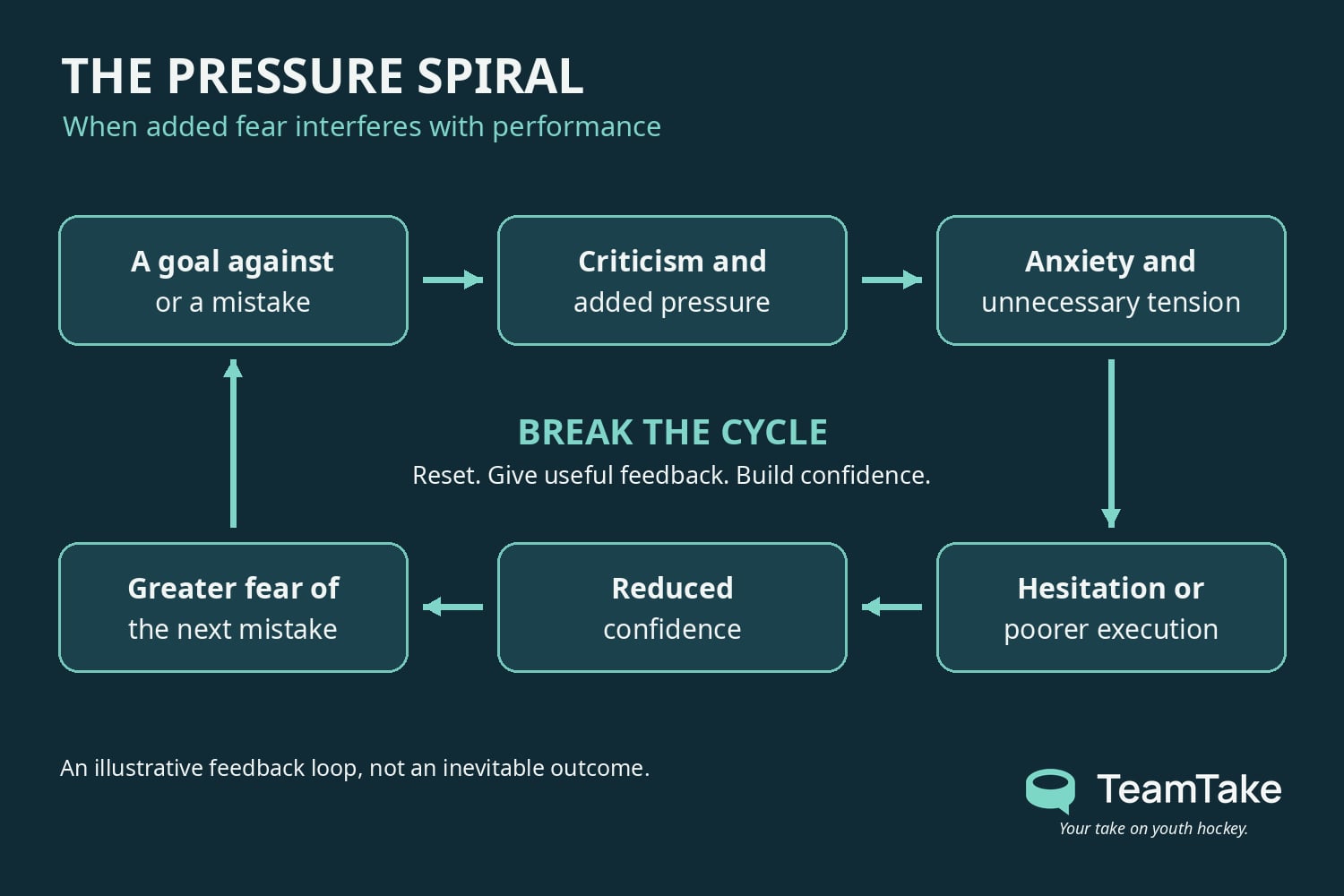
When criticism adds fear rather than useful information, it can reinforce the very problem a coach is trying to correct.
A goalie who gets beaten may already be painfully aware of the result. Instead of yelling “You have to stop that,” a coach could ask whether there was a screen, whether the goalie lost sight of the release or whether their positioning needs work. They might also involve someone who understands the position well enough to offer specific advice. Sometimes the most useful response is simply to help the goalie move on to the next shot.
You cannot intimidate a young goalie into becoming confident.
For a closer look at responding to goals against, see When the Puck Goes In: Helping Young Goalies Learn Without Blame.
What can parents actually do?
It can be difficult to admit that the program you worked so hard to get your child into might no longer be the right place for them. You've made the financial commitment, organized your family around the schedule and perhaps turned down other opportunities. Your child may be determined to stay at a particular level, even while struggling with the environment.
Start by listening. Ask what happens at practice, what feedback they receive and whether there are moments when hockey still feels enjoyable. Try to understand before deciding whether the coach is at fault. A child who wants to leave because the sport no longer interests them deserves to be heard just as much as one who wants to escape a difficult team.
Make home somewhere they can recover from the pressures of hockey. They probably don't need a second coaching session on the drive home. If they want advice, give it; if they need someone to listen, do that instead. When a child's distress persists or affects daily life, seek appropriate professional support.
Where possible, maintain a realistic Plan B. Keep friendly relationships with other teams, coaches and organizations. Learn about registration deadlines, releases, transfer rules, fees and actual roster availability before relying on an alternative. A different program, a lower competitive level or a temporary break can be a better option than remaining somewhere simply because you've already paid. Don't make a child feel that changing teams means failing.
Your child's hockey future shouldn't depend on one adult's opinion.
If you have concerns, talk to other parents and, when appropriate, raise specific questions respectfully with the coach or organization. An independent skills or goalie coach can sometimes help separate genuine technical development needs from problems in the team environment. Keep a factual record of recurring incidents rather than relying on impressions or rumours.
Not everyone feels comfortable having those conversations in person. That's one of the reasons we built TeamTake. Verified team members can start anonymous discussions with others in their own team or organization, compare experiences and discover whether concerns are shared. They can also leave public, anonymous reviews of organizations where they have verified team membership. Honest positive reviews are equally useful. Share firsthand experiences, avoid identifying children, and remember that details can still reveal identities in a small community.
Several families who independently identify a problem may be better positioned to ask for a constructive change than one parent acting alone. TeamTake can help them find each other, although it cannot guarantee an organization's response or prevent retaliation.
For more on this, see The Things Hockey Parents Don't Say Out Loud.
If there is suspected abuse, bullying or serious misconduct, don't wait for a consensus or rely on an online discussion. Use the applicable reporting process, such as Hockey Canada's independent safe-sport reporting process or USA Hockey's Safe Sport reporting channels. For independent programs, check their governing body's procedures. Contact the appropriate authorities when child protection or immediate safety is at issue.
The coach a child remembers
There is another side to this story. Coaches who notice a player losing confidence and take the time to help. Coaches who give a child a second chance. Coaches who are demanding enough to help players accomplish things they didn't think possible, but never make those children feel worthless when they fall short.
Those are often the adults who make hockey such an extraordinary part of a child's life.
Years from now, your child might not remember where their U13 team finished in the standings. They might not remember which tournament they won or how many goals they scored in a particular season. But they may remember the coach who believed in them when they were struggling, and who made them want to come back to the rink the next day.
They may also remember the coach who made them want to leave.
It is worth thinking about which of those legacies matters more than a trophy.
Join the conversation at TeamTake.
TeamTake | Your take on youth hockey.
GentleSparrow826
Some people were fantastic players and should still never be put in charge of kids. I don't care where you played, if you regularly humiliate a 12 year old because you're frustrated then you shouldn't be coaching children. Too many parents will excuse absolutely anything once they hear "played pro."
BreezyRabbit208
We dropped down a level after a pretty miserable U13 season, which at the time felt like a huge deal to all of us. A month later he was asking to go to public skating with his friends again, something he hadn't wanted to do for ages. Wish we'd worried less about the team name on his jacket.
LightRobin225
My kid's favourite coach was also his hardest one, so I hope people don't read this as saying a demanding coach is automatically a problem. He'd sit you for a lazy backcheck, but he'd explain it and you got another chance. What bothered us with a different coach was never knowing how to get back in his good books, even when the effort was there.