TeamTake editorial
Your Child Didn't Make AAA. What Now?
PatientBadger382 · Published
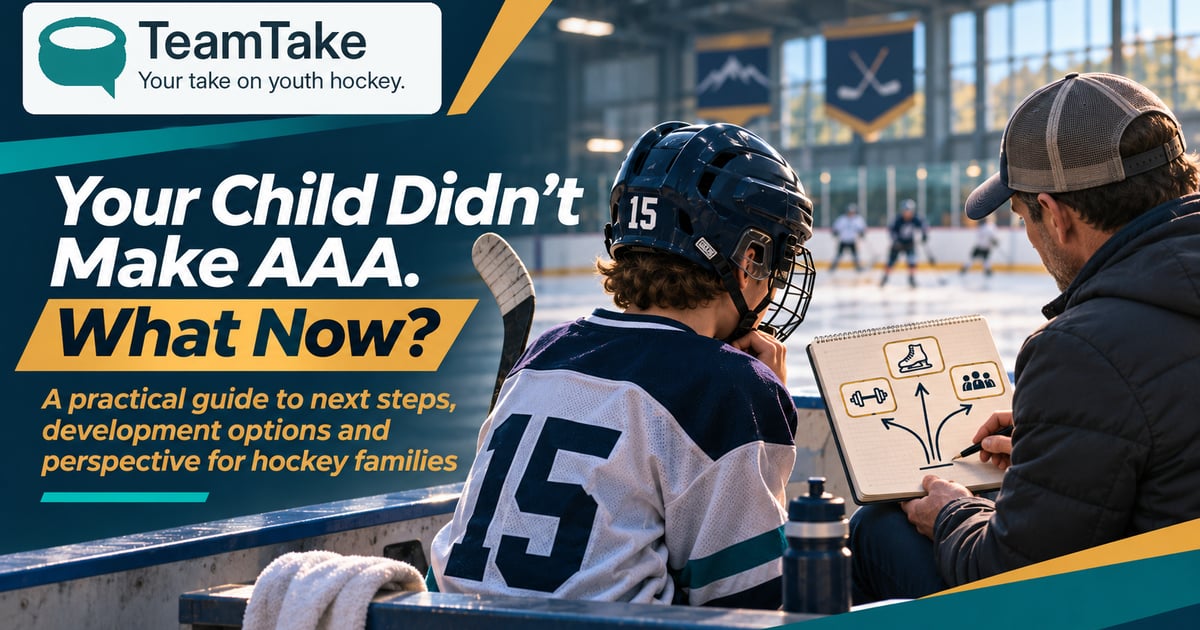
How to turn a disappointing tryout into a useful development plan — without giving up on ambitious hockey goals or chasing the next available AAA label.
The roster announcement comes out. Your child checks the list, then checks it again. Some friends made the team. Their name isn't there.
For a competitive hockey family, a missed AAA selection can feel like more than losing a roster spot. It can feel like losing a season of development, falling behind other players, or missing the beginning of a junior hockey pathway. Parents may wonder whether they should look for another academy, pay for additional training, challenge the evaluation or accept a lower-level team.
Those are reasonable questions. But they are not all the same question, and they don't need to be answered in one evening.
A tryout tells you that your child wasn't selected for a particular roster at a particular time. It does not, by itself, tell you what their best development environment will be for the next eight months.
This guide is for families who want to remain ambitious while making a realistic decision about what comes next.
1. What does missing AAA actually mean?
AAA generally identifies a high competitive classification within a particular hockey system. It does not identify one universal standard across provinces, independent leagues, school programs or age groups. Prep describes a program format or division, not a universally separate level above or below AAA. For the differences, see What Does AAA Actually Mean in Youth Hockey?.
Selection can reflect several things at once:
- How effectively the player performed in the evaluation sessions and games.
- Their present skating, puck skills, decisions, physical readiness and consistency.
- The needs of the roster, including position, returning players and available spots.
- The number and strength of other candidates.
- Eligibility, geography, roster rules and the particular evaluation process.
A coach may reasonably select another player who better meets an immediate roster need. A missed selection may also reveal a meaningful technical gap. In some cases an evaluation process may be imperfect. None of these explanations should be assumed without evidence.
There is another important distinction: selecting a team for the coming season is different from predicting how every candidate will develop over several years.
A 2025 longitudinal study of international ice hockey pathways examined development in Canada, Finland, Czechia and Slovakia. Players born earlier in their selection year were overrepresented in early career stages, while relatively younger players became more prominent during the transition to junior hockey. This is an example of the relative age effect, where the timing of a birth date within an age group can influence selection opportunities.
Relative age isn't the same thing as physical maturity. A relatively young player can mature early, and an older player can mature late. Neither characteristic tells us how any individual career will unfold. The study does not establish the odds of a rejected AAA player eventually reaching junior hockey; it does show why early selection should not be treated as a permanent ranking of potential.
2. The first few days: respond before reacting
The player may be embarrassed, angry, relieved, motivated or simply tired of tryouts. Start by finding out what they actually feel and want rather than assuming their goals match yours.
A useful first conversation could be: “I know you wanted that spot. Do you want to talk about the evaluation, or would you rather leave it for tomorrow?”
There is no need to pretend the outcome doesn't matter. Competitive players care about making teams. But a disappointed child also doesn't need a review of every mistake on the drive home, comparisons with selected friends, or a promise that the coaches will regret their decision.
At the same time, registration deadlines can be real. Check the deadline for the available alternative roster, whether an offer can be held, and the rules on releases and transfers. Give the player emotional space while keeping practical options open.
3. Get feedback that can actually change something
When an evaluation process allows feedback, a short, respectful request is worth making. Depending on the organization, individualized reports may not be available; don't assume coaches can explain other players' selections.
| Less useful question | More useful question |
|---|---|
| Why did you cut my child? | Which two or three areas would most improve their readiness? |
| Why did that player make it? | What standard did you expect at this position? |
| Are they good enough for AAA? | What needs to become more consistent in game situations? |
| Will they make it next year? | What progress would you want to see at the next evaluation? |
If feedback is vague — for example, “needs more speed” or “not ready” — ask what that looked like in a drill or game. Does speed mean acceleration, edge work, quicker puck decisions or the ability to maintain pace across a shift? Those are different training priorities.
The Ontario Hockey Federation's U15 player pathway describes preparatory skates and evaluations based on a range of skills and game concepts. Hockey Canada's player development resources include evaluation and skill-development tools, including for goalies. These are useful starting points, although an individual academy or league may have its own selection process.
If there is a documented procedural problem, check the organization's written review or appeal process promptly. A fair-process question is different from disagreeing with a coach's hockey judgment. Avoid making allegations about other children or sharing their evaluations in public.
4. Choose the next team, not the next label
A higher-level team can bring faster opponents, more demanding practices, strong peers and greater scouting exposure. Those advantages are meaningful, especially for a player who is ready for them. But the advantages only matter if the athlete actually gets an appropriate opportunity to develop.
Here are several possible choices after a missed AAA selection.
| Option | What it may offer | What to check |
|---|---|---|
| Strong AA or top association rep team | Significant game responsibility, competitive hockey, local schooling | Opponent quality, coach, actual role and development plan |
| Another AAA opportunity | Comparable or stronger competition if the roster fit is right | Genuine opening, eligibility, travel and playing opportunities |
| School-based academy or Prep program | Integrated training and education, structured development | League level, academic plan, roster depth, total cost |
| Independent competitive program | Additional roster and scheduling options | Sanctioning, insurance, opposition, transfer implications and verified track record |
| Local team with targeted additional coaching | Flexible, affordable development around specific needs | Suitable game challenge, quality coaching, sustainable schedule |
These are alternatives, not a ranking. Some regions use different labels or have restrictions on where players can register. Not every option will be accessible in every town.
For families in British Columbia, see BC Youth Hockey Pathways: From U13 to U15 AAA and Beyond and BC Youth Hockey Beyond U15: From AAA and Prep to Junior Hockey. Before leaving sanctioned hockey, check the current Hockey Canada non-sanctioned league policy guidance and your provincial branch's rules. Restrictions can affect same-season return and affiliation; BC Hockey has its own explanation. Obtain written clarification for the coming season rather than relying on verbal assurances.
5. A stronger role or a stronger league?
Imagine two hypothetical 14-year-old forwards.
One receives a depth role on an elite team, practising at a very high pace but playing relatively limited game minutes. The other joins a good AA team, faces meaningful competition, plays regularly in different game situations and has a coach who gives individual feedback.
Which is better?
There is no universal answer. The elite practices could be the stimulus the first player needs, particularly if their game role is expected to grow. The second player may develop more confidence and decision-making through meaningful repetitions under pressure. But if the AA games are too easy and the player is rarely challenged, more minutes alone may not be enough.
Ask about the combination of training quality, competitive challenge, actual opportunity and feedback. Hockey Canada's U15 development guidance emphasizes skills and tactics alongside team play. It is worth asking whether those skills transfer to games rather than judging practices solely by intensity.
For a deeper discussion of roles and rotation, see Making the Team Is Just the Beginning: Understanding Playing Time in Youth Hockey.
6. If your child is a goalie, roster math matters even more
Goalies have fewer available roster positions and their game minutes are less easily distributed than those of skaters. A goalie may be one of several similar candidates for two positions. Missing a team does not necessarily imply a large gap in ability.
Consider two hypothetical offers for a 40-game season:
| Higher-level team | Strong alternative team | |
|---|---|---|
| Expected starts (not guaranteed) | 8 | 20 |
| Share of scheduled games | 20% | 50% |
| Dedicated goalie coaching | Ask for actual schedule | Ask for actual schedule |
| Opponent quality | Higher in this example | Competitive in this example |
The second goalie could get 12 additional starts — 2.5 times as many as the first — if those estimates materialize. But game counts alone cannot establish developmental value. Compare meaningful shots, ability to read plays, game video, quality of practices, individual goalie instruction and whether either role could change.
A goalie who played very little last season may benefit from a year of predictable competitive game experience. Conversely, a goalie who dominates a lower league and needs faster releases, more traffic and greater decision pressure may benefit from stronger competition.
Historical College Hockey Inc. research found that 60% of the 201 men's NCAA Division I goalies in its 2023–24 roster study were playing youth, prep or high school hockey at 17. This is retrospective evidence about goalies who reached college, not a success rate for all youth players. It predates the major junior eligibility changes and newer NCAA age-based rules. Still, it challenges the idea that a goalie must move to junior at the first possible opportunity.
Ask prospective teams how many goalies will dress, whether there is a planned rotation, who decides starts, how goalie-specific coaching is delivered and how the arrangement changes in playoffs. For more on emotional development, see When the Puck Goes In: Helping Young Goalies Learn Without Blame.
7. Build a development plan instead of buying more hockey
A good plan starts with the player’s actual needs, not with a calendar full of ice sessions. Choose a small number of priorities, agree on the work with a qualified coach and review progress periodically.
| Period | Action | Evidence of progress |
|---|---|---|
| First two weeks | Collect feedback, choose a suitable roster, agree on goals | Clear role, schedule and two or three skill priorities |
| First 6–8 weeks of the season | Practise targeted skills and review game clips | More consistent execution in actual games |
| Midseason | Reassess strengths, limitations, game role and enjoyment | Coach feedback and representative game footage |
| Late season | Evaluate improvement and identify realistic next-level options | Updated development plan and tryout preparation |
| Off-season | Balance targeted training, rest, other activities and evaluations | Readiness for the next season, not just camp attendance |
Examples of useful priorities include quicker puck decisions under pressure, improved first-step acceleration, better defensive reads or more consistent rebound control. A few representative game clips can be more informative than a collection of highlight goals or saves.
Additional coaching can help when it solves an identified problem. It is not automatically helpful to replace every free evening with hockey. The American Academy of Pediatrics' 2024 clinical report on overtraining and burnout explains the importance of recovery and the risks of excessive training. Persistent pain, fatigue, declining enjoyment or worsening school performance warrant attention, not simply more work.
Our spring hockey guide discusses choosing between training, tournament teams, evaluations and time away from the rink.
8. Will missing AAA close junior or college doors?
At U13 and U15, it is generally too early to conclude that a single missed roster has ended a player's future in competitive hockey. At U16–U18, the available time to demonstrate readiness becomes shorter and the level of competition and exposure may matter increasingly.
Major junior drafts and roster decisions are real milestones. A player who isn't selected may miss certain immediate opportunities, and teams may have restrictions around player rights, eligibility or registration. But a draft is not the only route to a roster; teams can also evaluate players later, subject to applicable rules. Other junior leagues and post-secondary programs have separate recruitment processes.
A player aiming at elite junior hockey should therefore remain realistic: they need to develop towards that standard and demonstrate it against suitable opponents, not simply wait for an opportunity to arrive. It may take a change in level or program as the player improves. There is no guarantee that hard work alone will produce a particular roster or scholarship.
For the actual Canadian and US routes, including major junior, Junior A and B, NCAA and U SPORTS, read Hockey Beyond U15: A Canadian Guide to Junior, College and Professional Pathways.
Education is worth protecting regardless of hockey results. If college hockey is a goal, understand NCAA international eligibility requirements and the timing rules long before graduation. A strong academic record is valuable even if a player ultimately chooses a different path.
9. When should you pursue a different AAA or academy offer?
It can make sense if the child wants it, the opportunity is genuine, the training and game environment address their needs and the family can sustain the cost and logistics. It makes less sense if the main reason is avoiding the embarrassment of playing at a different level.
Before committing, ask yourself:
- Would we still choose this team if its league did not use the AAA label?
- Is the player likely to receive meaningful game opportunities?
- Does the program have coaches who can help with the feedback we received?
- Can the child maintain school, rest, friendships and enjoyment?
- Are we paying for a demonstrated opportunity, or for a promise about the future?
A missed tryout can create urgency that makes an expensive offer seem more attractive than it would have looked a week earlier. Where possible, compare it with the available local option rather than with the team your child didn't make.
A season is still a season of opportunity
It is possible to acknowledge the disappointment without abandoning ambition. Some players need a different competitive challenge, some need more time to develop, and some discover that their goals change as they grow.
The next team should offer the best realistic environment for the child to become a better player and a healthier, more confident person. That is a more useful objective than proving that a particular selection decision was wrong.
The question is not just whether your child will make AAA next year. It is whether the next season will help them become a better hockey player — and still want to play the game.
Join the conversation
Has your child missed a team they wanted to make and found a positive alternative? What helped them develop afterward? What would you do differently? Share your experience on TeamTake, without identifying or criticizing individual youth players.
Sources and editorial notes
- Relative age effects and player pathways in international ice hockey: a longitudinal multi-cohort analysis (2025)
- Hockey Canada — U15 development guidance and development resources
- Ontario Hockey Federation — U15 Player Pathway
- Hockey Canada — Non-Sanctioned Leagues Policy update; BC Hockey guidance
- College Hockey Inc. — Goalie Paths: How They Get to NCAA Division I (updated 2024)
- American Academy of Pediatrics — Overuse Injuries, Overtraining, and Burnout in Young Athletes (2024)
- NCAA — International Student Initial Eligibility Requirements
Examples and roster scenarios are illustrative, not reports of actual players. This independent editorial does not endorse a particular program or predict individual advancement. Confirm registration, eligibility and selection policies for 2027–28 with the relevant organizations.
Comments
Be the first to comment.