TeamTake editorial
New to Hockey? A First-Time Hockey Parent's Guide
GentleDuck546 · Published · Updated
What experienced hockey families may assume you already know.
You arrive at the rink for your child's first hockey session. Other parents seem to know exactly where to go. Someone mentions a dressing room, another asks whether the skates have been sharpened, and a coach tells everyone to be ready fifteen minutes before the ice time.
You are still trying to figure out which way the hockey stick should curve.
If you didn't grow up playing or watching hockey, the first season can feel like learning a new language. Even parents who played as children may discover that registration, equipment, age groups and expectations have changed considerably.
The good news is that you don't need a hockey background to become a good hockey parent. You don't need to understand every rule, buy the most expensive equipment or know which team your child should play for five years from now.
This guide covers the practical things hockey families in Canada and the United States often learn through experience. Local programs differ, but the fundamentals are similar. Where the rules differ between Hockey Canada and USA Hockey, we'll point that out.
1. Where to start: you don't need a team yet
There is a difference between learning to skate, learning to play hockey and joining a hockey team. Some beginner programs combine these stages, while others expect children to have basic skating skills before registering.
| Starting point | What to look for |
|---|---|
| Never been on skates | Learn-to-skate lessons, supervised public skating or an introductory hockey program that accepts complete beginners. |
| Can skate a little | Learn-to-play hockey or beginner skills sessions that introduce puck handling, stopping and changing direction. |
| Can skate and wants to play games | A suitable house, recreational or beginner league with age-appropriate coaching. |
| Already plays another sport or is starting as an older child | Ask about age-appropriate novice groups, skill assessments and recreational programs rather than automatically joining the youngest beginners. |
Being able to skate confidently enough to participate makes hockey more enjoyable. However, children don't need perfect technique before they can pick up a stick. Skating and puck skills can develop together.
Look for introductory programs that lend or include equipment. In Canada, Hockey Canada's beginner resources include the NHL/NHLPA First Shift and local learn-to-play opportunities. In the US, USA Hockey's Try Hockey For Free and Find Hockey Near You are useful starting points.
First Shift is designed for children ages 6–10; USA Hockey’s national Try Hockey For Free events generally target ages 4–9, although some hosts offer broader age ranges. Check current eligibility and availability before registering. If your daughter wants to play, ask about girls-only and co-ed options. The best choice depends on the programs available locally and where she feels comfortable developing. Adaptive and inclusive hockey programs are also available in many communities.
When is the right age to start hockey?
Some hockey families introduce their children to the ice almost as soon as they can walk. Others discover hockey at eight, ten or even in their teenage years. A new parent may reasonably wonder whether those early years make a difference.
They can. Skating is a relatively specialized skill, and a child who has spent several years becoming comfortable on the ice may have a considerable advantage over someone learning to stop and turn for the first time. That advantage can matter at competitive tryouts. But starting early is not the same as training intensively or specializing in hockey year-round.
| Starting age | A sensible approach |
|---|---|
| Preschool (roughly 3–5) | Short, playful skating sessions if the child is interested and ready. No pressure to master hockey skills or join a competitive team. |
| Around 5–8 | Learn to skate and learn to play; build balance, stopping, turning and basic puck skills through enjoyable activities. |
| Around 9–12 | Look for age-appropriate instruction and a suitable team. Target skating and puck skills that will help the child participate confidently. |
| Teen years | Find a welcoming recreational or beginner program. An athletic background can help, but allow time to learn hockey-specific movement, rules and game decisions. |
These are examples, not deadlines. An older beginner may learn quickly, particularly with good instruction and experience in other sports. However, catching peers who have accumulated years of ice time is a real challenge if the goal is a highly selective AAA team or elite academy. It becomes harder as the available development time before competitive selection narrows. A realistic intermediate target might be becoming a confident skater, then earning a meaningful role on a suitable local team before attempting higher-level tryouts.
For a very young child, the objective is comfort, enjoyment and broad movement skills, not an early hockey résumé. A 2018 study of male professional and collegiate hockey players found that the surveyed athletes specialized in hockey, on average, after age 14; many played other sports as children. This retrospective study of successful athletes cannot establish which pathway causes better outcomes, the ideal age to start skating, or the ideal age to specialize as a goalie. Starting young and giving up all other sports young are different decisions.
Is it too late to start? For enjoying hockey, almost never. For a particular elite opportunity, the answer depends on the child's existing skills, age, motivation, opportunities and rate of improvement. Be honest about the competitive challenge without letting it become a reason not to start.
2. Who actually organizes youth hockey?
In Canada, many families register through a local minor hockey association (MHA), which operates within a provincial or regional Hockey Canada member. In the US, families often join a local club or association affiliated with USA Hockey through its district or affiliate structure.
There are also private clubs, academies, independent leagues and school hockey programs. Not every program is governed by the same organization.
You may encounter several different payments or registrations: a national membership, local association registration, tryout fees, and team-specific fees. These are not necessarily duplicates; ask what each one covers.
| Term | What it usually means |
|---|---|
| Association / club | The organization that registers players, forms teams and arranges programming. |
| Team | The group your child practises and plays games with. |
| League | The competition in which teams play. |
| Sanctioned hockey | Hockey operating under a particular governing body's recognized rules, registration and policies. |
| Independent hockey | A program operating outside that governing body's system. It may have its own rules, insurance and safeguards. |
| Registrar | The person who handles player registration and eligibility questions. |
Before paying, confirm the correct registration process, the association's geographic boundaries if any, and its player release or transfer rules. Proof of age and residency may be requested. If a program operates independently, ask who provides insurance, which safety and complaint procedures apply, and whether participation affects eligibility elsewhere.
The official registration starting points are Hockey Canada and USA Hockey's youth hockey resources.
3. U9, 10U, U13, 14U: understanding age groups
Canadian and American youth hockey generally organize children by birth year rather than school grade. For a season beginning in 2027, the age used in the standard age classifications is the age the child reaches by December 31, 2027. The names can look confusing across the border: Canada uses U15 for ages 13–14, while USA Hockey uses 14U for the same age band. The US label includes the upper age; the Canadian label means under the indicated age.
| Typical age in the classification year | Canada (Hockey Canada) | United States (USA Hockey) |
|---|---|---|
| 5–6 | U7 | 6U (some programs combine younger age groups) |
| 7–8 | U9 | 8U |
| 9–10 | U11 | 10U |
| 11–12 | U13 | 12U |
| 13–14 | U15 | 14U |
| 15–16 | U18 in most minor hockey; U17 in some programs | 16U; some 15-only opportunities |
| 17 | U18 | 18U (youth) / 19U (girls) |
| 18 | U21 where offered; other older-age pathways | 18U (youth) / 19U (girls) |
| 19–20 | U21 where offered; other older-age pathways | Girls 19U at age 19; otherwise older-age programs |
These are orientation labels, not an eligibility chart. Always use the published birth-year table for the specific season, league and division. For example, a 2013-born player is in U15 under the standard Canadian minor hockey system and 14U under USA Hockey for 2027–28, under the usual birth-year structure (confirm the published 2027–28 classifications before registering). A child's birthday during the season does not normally mean switching teams halfway through it.
What happened to Atom, Peewee, Bantam and Midget?
Canada adopted its numbered age-division names for the 2020–21 season. USA Hockey also moved away from traditional names in its official terminology, but many clubs, tournaments and families still use them informally. If an older hockey parent says their child played Atom or a tournament advertises a Squirt division, they are talking about age, not skill level.
| Typical age | Older Canadian name | Canada today | Older US name | US today |
|---|---|---|---|---|
| 6 and younger | Initiation / Timbits | U7 | Mini-Mite (informal) | 6U programming |
| 7–8 | Novice | U9 | Mite | 8U |
| 9–10 | Atom | U11 | Squirt | 10U |
| 11–12 | Peewee | U13 | Peewee | 12U |
| 13–14 | Bantam | U15 | Bantam | 14U |
| 15–16 | Midget | U18 (or narrower local divisions) | Midget Minor | 16U (also 15-only in some programs) |
| 17 | Midget | U18 | Midget Major | 18U (youth) / 19U (girls) |
| 18 | Juvenile (where offered) | U21 where offered | Midget Major | 18U (youth) / 19U (girls) |
In Canada, U18 ordinarily covers ages 15–17, while the US youth categories divide older players differently. US girls' classifications can include 19U. Programs may also split divisions by individual birth year or use their own labels. These are approximate equivalents of the terminology used before the modern labels, not a substitute for checking current eligibility. Older historical eras and local associations may have used different cutoffs. In Quebec, the French equivalents include M11, M13, M15 and M18.
Sources: Hockey Alberta's report on the Hockey Canada age-name change, Hockey Canada age divisions, and USA Hockey youth classifications. For examples of older American terminology, see Grand Valley Amateur Hockey Association's explanation of the naming change.
For official information, consult Hockey Canada's pathway to minor hockey and USA Hockey's age classifications.
4. House, rep, travel, AA, AAA and Prep: what level should we choose?
Your first hockey registration does not need to be a career decision.
| Program | What families can generally expect |
|---|---|
| House / recreational | Local participation, a relatively accessible schedule and development at a range of abilities. Not just for beginners. |
| Rep (representative) / travel | Selection or evaluation, more structured competition and often greater travel, fees and time commitment. |
| A / AA / AAA | Competitive classifications that vary by league and region. AAA is commonly the top classification within a particular system. |
| Tier I / Tier II (US) | USA Hockey competitive classifications in applicable divisions; Tier I is often associated with AAA and Tier II with AA or other designations. |
| Prep / academy | A program format combining hockey development with school or education arrangements in many cases. The label does not, by itself, establish competitive level. |
| Skills program / spring team | Additional development or seasonal competition outside the main winter team, not necessarily a replacement for it. |
The labels do not translate neatly across every province, state or independent league. A strong local team with excellent coaches may offer more suitable development than a higher-labelled team where a child struggles to participate.
A tryout is a selection process; an evaluation or placement skate may instead be used to create balanced teams or group players by current skill. Ask which it is. In competitive hockey, registration for a tryout does not guarantee a roster spot, and attending a camp does not mean a child has been recruited.
For a beginner, the most useful questions are: Will my child receive instruction appropriate to their current skill? Will they actually play? Can our family sustain the schedule? Does my child want this level of commitment?
When these distinctions become relevant, read TeamTake's What Does AAA Actually Mean in Youth Hockey? and Your Child Didn't Make AAA. What Now?. If you are comparing school-based or independent academy programs, see Are Hockey Academies Worth the Money?.
5. What equipment does a child actually need?
A player needs more than skates, a helmet and a stick. The following is a typical full set for a youth skater; confirm exact protective requirements with your program before buying anything.
| Equipment | What a new parent should know |
|---|---|
| Helmet and full facial protection | Properly fitted, unmodified and certified: CSA for Hockey Canada; HECC for USA Hockey youth. In the US, the helmet must have a current HECC certification sticker, including its expiry date. |
| Neck laceration protector / neck guard | Required in Hockey Canada minor hockey (BNQ certification) and USA Hockey youth hockey (HECC certification, with a temporary BNQ allowance explained below). A neck warmer is not a substitute. |
| Shoulder pads | Protect the chest, shoulders and upper body. Must fit without restricting normal movement. |
| Elbow pads | Cover the elbow securely and should not slide out of place. |
| Hockey pants / breezers | Padded pants, not ordinary trousers or just a shell. |
| Protective cup or pelvic protector | Often called a jock or jill; may include attachments for hockey socks. |
| Shin guards | Cover the knees and shins; fit with the skates and other equipment. |
| Hockey gloves | Padded gloves that still allow grip and wrist movement. |
| Hockey skates | A snug, properly fitted boot with sharpened blades. Street shoe size alone is not a reliable guide. |
| Hockey stick | Correct length, curve and flex for the child's size, strength and preference. |
| Hockey socks and jersey | Hockey socks cover the shin pads; they are not the same as socks worn inside skates. The team may supply jerseys and socks. |
| Base layer and skate socks | Comfortable, washable clothing worn under equipment. |
| Bag and water bottle | Label both, and keep a small set of spares in the bag. |
A cross-border equipment detail worth knowing: USA Hockey’s 2025–29 Rule 304(g) accepts BNQ-certified neck protectors as an alternative to HECC certification only through the 2026–27 season. Under the current rule, a BNQ-only protector will not be sufficient for the 2027–28 USA Hockey season. Check for HECC certification before buying for US play, and ask the tournament or association about any applicable cross-border rules. Hockey Canada requires BNQ-certified throat protection for minor hockey, including goalies.
Do kids need a mouthguard? Not universally. In Hockey Canada minor hockey, a mouthguard is generally not nationally mandated where full facial protection is required, although a member or local program may require one. USA Hockey's protective equipment rule requires a non-clear internal mouthguard for players, including goalies, in youth and girls' 12U through youth 18U (including high school) and girls' 19U classifications. USA Hockey also recommends a professionally fitted mouthguard across age classifications, including where it is not mandatory. In Canada, divisions permitting half visors have additional mouthguard rules; that is not the usual minor-hockey situation. Confirm your program's rules, including any cross-border tournament requirements. See Hockey Canada 2026–28 playing rules, Rule 3.6 and Interpretation 2, USA Hockey 2025–29 rulebook, Rules 303(b) and 304(c)–(g), and this cross-border rules summary from the Michigan Amateur Hockey Association.
See Hockey Canada's equipment fitting videos for visual guidance on each piece.
Used gear is often a good choice — with exceptions
Children outgrow equipment quickly. Used shoulder pads, pants, gloves and other gear in suitable condition can save a family substantial money. Equipment swaps, club lending programs and reputable used sporting goods stores are worth exploring.
Be more cautious with helmets, cages, neck protectors and other safety-critical equipment. If you cannot confirm a helmet's history, certification, condition and usable life, choose a properly fitted new one. Reject damaged equipment and anything that no longer provides secure coverage. Never assume a larger size is safer just because it will last longer.
Expensive sticks and skates are not prerequisites for a beginner. The fit and suitability of the equipment matter much more than the product tier. A stiff, advanced skate can be uncomfortable for a new skater, and an overly stiff stick may be difficult for a small child to use effectively.
Which way should the stick curve?
Hockey handedness is not the same as writing handedness.
- A left-shot player generally has the left hand lower on the stick and the right hand at the top.
- A right-shot player generally has the right hand lower and the left hand at the top.
Let your child try both sides before committing to a curved stick. Many right-handed people shoot left, and vice versa. Do not force a choice just because of the child's dominant hand. For a very young beginner, ask the instructor whether a straight blade is suitable.
The skate details nobody tells you
New skates often need an initial sharpening before they can be used. Ask the skate shop to check them. Sharpening creates two edges on each blade, not simply a pointed knife-like edge.
A sharpening's hollow (such as 1/2 inch or 5/8 inch) affects the balance of grip and glide. Neither is universally best; ask the shop or coach for an appropriate starting point for your child's weight and ice conditions rather than changing it every week.
Sharpening frequency depends on ice time, blade condition and preference. If the child suddenly slips when turning, or a blade is nicked, have the edges checked. Use hard skate guards when walking on suitable off-ice surfaces, take them off before stepping on the ice, and wipe the blades dry afterward. Fabric soakers can protect blades during transport; remove damp covers for drying at home.
Write the child's name on equipment and keep a spare stick if the program requires or recommends one. Spare laces, stick tape, sock tape and a small towel are handy. There is no need to buy every accessory before the first practice.
Getting dressed and drying equipment
Practise putting on the equipment at home. A common sequence is base layer and pelvic protector, shin pads and hockey socks, pants, skates, shoulder pads, elbow pads, neck guard, jersey, helmet and gloves. The exact sequence can vary; check fit and coverage at the end. Let children gradually learn to dress themselves, with help where appropriate.
After every ice session, unpack the bag and air-dry the equipment. Wash washable items according to the manufacturer's instructions. A zipped bag full of damp gear is a recipe for persistent odour. Check for loose screws, damaged straps, worn laces and sharp or broken parts before the next session.
6. What if your child wants to be a goalie?
Some hockey parents never saw it coming 🥅 😊
Goalies use different equipment: a properly approved mask, chest and arm protector, goalie pants, leg pads, catcher, blocker, goalie stick, appropriate skates and required neck and pelvic protection. A dangling throat protector attached to the goalie mask helps protect against puck impacts but does not replace the required certified neck laceration protector. Verify the mask, neck protection and other goalie gear with a knowledgeable fitter and the governing body; do not assume a non-certified cage is legal in youth hockey.
Do not buy an entire expensive goalie set simply because your child enjoys one session in net. Many beginner programs rotate players through the position and have loaner equipment. Ask about fitting, introductory coaching and whether the child can continue skating out as well.
When should a child become a full-time goalie?
There are different views on when to commit to the position. Some children are fascinated by goaltending from their very first hockey season, while others play forward or defence for several years and switch to goalie around U11 (10U in the US), or later.
Hockey Canada's goaltending development guidance encourages children to develop a broad skill set and avoid premature positional specialization. Its U9 guidance recommends rotating players through the position rather than appointing permanent goalies. USA Hockey also recommends against full-time goalies at 8U. USA Hockey's age-appropriate goalie development guidance likewise supports opportunities to try both skating out and goaltending at younger ages.
There are good reasons for this approach. Playing out develops forward and backward skating, edge control, puck handling, passing and the ability to read the game from the perspective of an attacker or defender. These skills can be useful in net. A child who switches later may already have a strong skating foundation, even if they are new to goalie equipment and technique.
On the other hand, goaltending has its own demanding skills: tracking, angles, depth, lateral movement, recovering after saves, rebound control and puck handling in goalie equipment. They are difficult to develop simply by standing in net during shooting drills. A child who starts at U11 may encounter peers who have already received weekly private goalie instruction since age six. That experience may give an early starter an immediate technical advantage at goalie-specific evaluations. This is a plausible developmental trade-off, not evidence that private instruction at age six produces better long-term goalies; there is no universal age or lesson schedule established by the guidance cited here.
| Approach | Potential advantages | What to watch for |
|---|---|---|
| Try goalie occasionally while skating out | Broad skating skills, game understanding and time to discover whether the position is enjoyable. | Limited goalie-specific practice if the child increasingly wants to play in net. |
| Start goalie instruction early, keep skating out where allowed | Develop some goalie technique without giving up general hockey skills. | Extra expense and scheduling; instruction must be appropriate for the child's age and interest. |
| Switch to a full-time goalie role around U11 or later | Can focus on specialist techniques once the child has a skating foundation and a clearer preference. | May need structured instruction and patience to close a technical gap with experienced goalies. |
| Commit early to a full-time role where permitted | More goalie-specific repetitions and opportunities to learn the position. | Losing opportunities to skate out, excessive load and pressure to remain in a position the child may later outgrow or dislike. |
These are trade-offs rather than a timetable for success. Follow local rotation and registration rules. A private lesson at age six is not a requirement for a future AAA goalie, and early training need not mean full-time specialization. A young goalie can benefit from a well-run group clinic, occasional goalie instruction and continued general skating. Once the child is committed and aiming for competitive selection, regular access to qualified goalie coaching becomes particularly valuable if team practices do not include it.
For a young goalie, getting actual game opportunities is important. When your child eventually joins a team with two goalies, ask how games and practices are divided, whether dedicated goalie instruction is provided and what happens during tournaments.
Goalies are not supposed to stop every puck, especially in beginner hockey. Praise effort and learning; a goal against is an ordinary part of the sport. See When the Puck Goes In: Helping Young Goalies Learn Without Blame.
7. Understanding the game from the stands
Hockey becomes much easier to watch once you recognize a handful of situations. You do not need to memorize the whole rulebook.
Who plays where?
In standard full-ice hockey, a team normally has five skaters and one goalie on the ice: three forwards (left wing, centre and right wing) and two defencemen. Penalties or other situations can change the number. Younger age groups may play smaller games across part of the rink, with different numbers of players and simplified rules.
Forwards attack and defend; defencemen defend and help create offence. The names are not instructions to stand in one place. At beginner levels, players may rotate positions rather than specialize immediately.
The rink and the lines
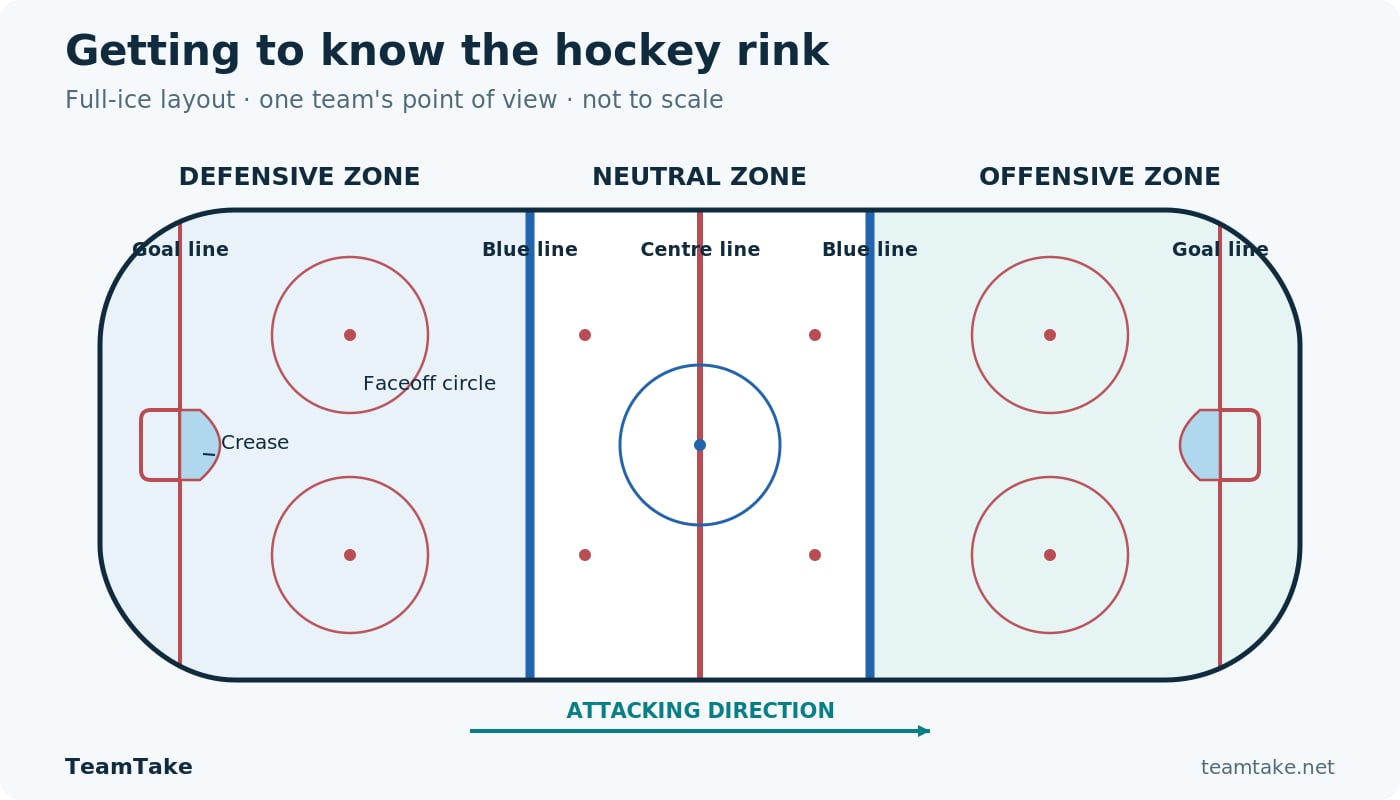
The attacking direction is shown for one team only. Teams change ends according to their game format.
The two blue lines divide a full rink into three zones: defensive, neutral and offensive. Which end is offensive depends on the team you are watching. Faceoff dots are places where officials restart play. The goal crease is the marked area around the front of each net.
Why did the referee blow the whistle?
| Term | Plain-English explanation |
|---|---|
| Faceoff | The official drops the puck between opponents to begin or restart play. |
| Offside | Normally the puck must enter the attacking zone before the attacking skaters cross the blue line completely. A player already across the line can put the team offside even without touching the puck. There are exceptions, including certain entries by a player already controlling the puck. |
| Icing | Generally, a player sends the puck from behind centre ice across the opponent's goal line without it being played, subject to exceptions. Play is usually restarted at the offending team's end. |
| Puck out of play | The puck leaves the playing area or becomes unplayable, so a faceoff follows. |
| Goalie covers the puck | The goalie holds or traps the puck, usually stopping play for a faceoff. |
| Penalty | An official calls an infraction, such as tripping, hooking or illegal contact. Consequences depend on the type of penalty and age group. |
| Power play / penalty kill | One team has a player advantage due to a penalty; the other tries to defend while short-handed. |
| Delayed penalty | The official signals a penalty but may allow play to continue until the offending team gains control or another stoppage occurs. |
| Empty net | A team has no goalie guarding the net, usually because the goalie has been replaced by an extra skater late in a game or on a delayed penalty. |
These explanations are deliberately simplified. Don't assume NHL rules apply to your child's game. For example, USA Hockey’s 2025–29 rules allow delayed/tag-up offside and short-handed icing in Youth 15-Only and older classifications and Girls 16U and older; at 14U and younger, immediate offside and the prohibition on short-handed icing still apply in full-ice games using those rules. In a delayed offside, the attacking players can generally clear the zone (tag up) before resuming the attack. Hockey Canada’s full-ice rules generally allow delayed offside and an icing exemption for a team that is short-handed, subject to age-specific and local modifications. See USA Hockey’s 2025–29 rule changes and Hockey Canada Rules 6.7 and 6.11. Tournament rules may differ.
A penalty usually means a player serves time in the penalty box, but not all penalties reduce the team’s on-ice strength. A minor penalty is commonly two minutes in a full-length game; shorter youth games may use shorter minor penalties. Check the game-length and penalty-duration rules for your league. A goal by the team on the power play can end certain minor penalties early, whereas major penalties follow different rules. Coincidental penalties, misconducts and other situations can complicate the scoreboard. Ask the coach or officials’ coordinator about the local rules if you are unsure.
Why do players keep leaving the ice?
Hockey is played in short bursts. Players take shifts and return to the bench to recover; another group replaces them. This is called a line change. Some changes occur during play, while others happen at stoppages. In younger games, a buzzer may signal that everyone should change at once.
A player coming off after forty seconds is not necessarily being benched. Nor does being on the ice for two minutes automatically mean they are getting better development. Coaches manage lines, fatigue and game situations differently.
Games often have three periods, but their length and whether the clock stops for whistles vary. You may hear running time (the clock keeps moving during many stoppages) and stop time (the clock stops for play stoppages). Overtime, shootouts and standings points depend on the league. A beginner game may use a completely different format.
Is body contact allowed?
Body contact and deliberate body-checking are different. Players can legally compete for the puck and make incidental or appropriate positional contact even in many non-checking divisions. That does not mean they may hit an opponent to separate them from the puck.
Hockey Canada prohibits body-checking at U13 and younger; older classifications depend on the program and rules. USA Hockey prohibits body checking in youth 12U and younger and all girls’ classifications. Hockey Canada also prohibits body checking in female hockey; older boys’ or mixed divisions may be checking or non-checking depending on the program. Some older youth divisions permit body-checking, while others remain non-checking. Confirm the exact division rather than relying on age alone.
Head contact, checking from behind and other dangerous conduct are not something a young player should be encouraged to tolerate. Learn the program's standards and report safety concerns appropriately.
Official references: Hockey Canada playing rules (2026–2028) and USA Hockey rules and resources (2025–2029).
8. Why are the youngest kids playing across the rink?
You may arrive expecting a full-size hockey game and discover two small games happening at the same time. That's normal in many introductory programs.
Hockey Canada’s U7 pathway uses cross-ice games; U9 uses half-ice programming and may transition to full ice on or after December 26 where the applicable member permits it. USA Hockey's American Development Model similarly emphasizes appropriately sized ice surfaces at young ages, including cross-ice and half-ice hockey.
Smaller playing areas give children more opportunities to handle the puck, make decisions, change directions and participate. A child who rarely reaches the puck on a full rink may have many more meaningful opportunities in a smaller game.
You might also see lightweight pucks, smaller nets, skill stations, timed shifts or no public standings. For USA Hockey 8U and younger, the lightweight blue puck is required by Rule 306(b); at 10U it is strongly recommended. These are development tools, not evidence that the program is failing to teach real hockey.
Sources: Hockey Canada U9 game formats and USA Hockey's development model.
9. Your first practice and game: the routine
The time in the schedule is often the start of the ice booking, not the time you should arrive at the building. Ask the coach or manager for the team's required arrival time. For a new player, arriving around 30 minutes before a session can be a reasonable starting point if the team has not specified a time; allow more time if dressing is unfamiliar, and follow the team’s required check-in time.
| When | What to do |
|---|---|
| The evening before | Check the schedule, rink address, jersey colours, equipment, skate condition and transport. |
| Before leaving | Bring water, a snack as appropriate, the complete equipment bag, stick and any required spare items. |
| At the arena | Confirm the rink sheet and dressing room number. Multi-rink facilities can have several games at once. |
| Before the ice time | Dress your child, check protective gear, remove hard skate guards before entering the ice and follow the team's supervision rules. |
| During the session | Watch from the designated spectator area. Give the coach space to teach; do not enter the bench or ice without authorization. |
| After the session | Wait for the team to finish its routine, collect belongings, dry equipment and check the next schedule. |
Bring warm clothing. An arena can be surprisingly cold even in spring or summer. Some facilities have heated viewing areas; others do not.
The Zamboni is a brand name often used for the ice resurfacing machine. Stay off the ice until the facility or coach permits access. Do not send children onto the ice while the machine is operating or before the rink gate is secured.
A few unwritten rules: don't stand where you obstruct other spectators, don't lean over the bench, and don't bang on the glass to get your child's attention. Pucks can leave the ice, so remain alert and obey arena safety signage.
10. Team apps, tournaments and the invisible work parents do
Much of youth hockey happens outside the rink. Teams commonly use TeamSnap, SportsEngine, a league portal or a group chat for schedules and communication.
- Mark availability: Coaches need to know whether your child will attend. Update the app and notify staff according to team rules if your child is ill or unavailable.
- Read schedule changes: Ice times and locations can change at short notice. Check the latest information before travelling.
- Learn who does what: The head coach manages hockey instruction and team decisions; the manager usually coordinates schedules, tournaments and administration; the treasurer handles team funds where applicable. Some roles are volunteer positions.
- Volunteer: Parents may be asked to run the clock, keep the scoresheet, organize events, manage fundraising or help with other duties. Training, screening and local permissions may be necessary. Ask rather than assume everyone knows the job.
- Understand tournaments: A tournament can involve several games over a weekend, travel, hotels, early starts and possible playoff games. Some events have designated hotel arrangements. Confirm costs, cancellation terms and documents before booking.
If there is a cross-border tournament, ask the manager about required team travel authorization, the child's passport, consent documents where applicable, and medical insurance coverage. A team registration does not replace border-entry requirements or travel insurance.
If you are unfamiliar with a volunteer task, say so. Learning to operate the scoreboard is far easier when someone shows you before the puck drops.
11. How much does hockey cost — and what isn't included?
The registration fee may be only part of your total spending. Ask for a written breakdown before registering, even if everyone around you seems comfortable with the price.
| Expense | Questions to ask |
|---|---|
| Registration and membership | Does the quote include national or local membership, insurance and taxes where applicable? |
| Equipment | What must we supply? Are there loaners, exchanges or team-provided jerseys? |
| Tryouts and evaluations | Are there separate fees? Are any refundable if the player is not selected? |
| Team fees | Are tournaments, extra ice, coach travel, apparel or team activities charged separately? |
| Travel | How many away games and tournaments are expected? Hotels, meals and parking? |
| Equipment maintenance | What about sharpening, replacement laces, tape and growth-related replacements? |
| Extra training | Is it optional or expected? What do camps and private lessons actually include? |
| Fundraising and volunteering | Are there mandatory commitments or deposits? What happens to any surplus team funds? |
For illustration, consider a hypothetical Canadian family budgeting for a local hockey season:
| Expense | Example budget (CAD) |
|---|---|
| Registration | $900 |
| Equipment | $450 |
| Team fees | $350 |
| Travel | $300 |
| Maintenance | $200 |
| Total | $2,200 CAD |
These are illustrative Canadian-dollar figures, not a survey of typical costs. US families should obtain quotes in US dollars (USD) and build a separate local budget using the same categories; the amounts above are not US prices or an exchange-rate conversion. A family using loaner gear or a subsidized beginner program may spend much less. Competitive travel hockey, tournaments, academies and additional training can cost considerably more.
Set a realistic family budget before the season rather than making every new expense an emotional decision about your child's future. You do not need year-round private training to justify the money you already spent.
Ask about payment plans, equipment libraries, local scholarships and financial assistance. Canadian families can investigate KidSport and Jumpstart; US families can ask their club or USA Hockey affiliate about local assistance and equipment programs. Coverage and eligibility vary.
12. A hockey season is more than the games
Winter hockey often begins with registration or evaluations months before the regular season. Depending on the location and level, the season may run from late summer or autumn into winter or early spring. Spring hockey, summer camps and off-season skills sessions may follow, but they are not compulsory parts of every child's development.
A beginner may attend a lesson or a couple of local sessions a week. A competitive team might have several practices, games and off-ice sessions, in addition to travel. Ask to see a representative weekly calendar, not just the advertised number of hours on the ice.
A 60-minute practice might consume two or three hours of a family's evening once commuting, dressing and unpacking are included. Early games and late practices can affect sleep, schoolwork and other activities. Build the schedule around the whole child.
Practice is not a lesser form of hockey. It gives players opportunities to repeat skills, receive feedback and make mistakes without the pressure of a scoreboard. Free play, rest and other sports also have value. If your child wants to explore spring hockey later, see Spring Hockey: What's the Right Plan for Your Child?.
The reality of competitive hockey: team practices may not be enough
A new parent might assume that registering for a team is the whole development plan: attend every practice, work hard and the next level will naturally follow. That is not necessarily how competitive selection works.
For recreational hockey, a couple of good team practices a week can be entirely appropriate. But when the objective becomes making a strong rep, travel or AAA team, especially in a competitive hockey market, families should anticipate that some or many of the other players at tryouts may have accumulated additional skating and skills work outside their team schedule. Additional targeted development is often a practical consideration in a competitive market, not a formal eligibility requirement. The amount needed depends on the child and the quality and volume of existing instruction; the sources below do not quantify how many AAA players receive private training or demonstrate that paid lessons are necessary.
For example, a team practising twice a week may have to divide its limited ice time among skating, passing, shooting, positional play and team tactics. A volunteer parent coach may be excellent, dedicated and well trained, yet still have limited time to correct each player's individual skating mechanics or a goalie's technique. The issue is not whether a coach is paid; it is whether the program delivers enough quality repetitions and useful individual feedback for the child's goals.
What might additional development look like?
| Need | Possible development activity |
|---|---|
| Skating, balance, acceleration and stopping | Power-skating classes, small-group instruction or purposeful practice on suitable public or stick-and-puck ice. |
| Puck handling, passing and shooting | Short, regular sessions at home where safe, skills clinics or small-area games. |
| Hockey sense and decision-making | Game-like practice, small-sided games, video review with a coach or playing other positions. |
| Goaltending technique | Goalie-specific group sessions, dedicated team goalie instruction or occasional individual coaching. |
| General athletic development | Age-appropriate strength, coordination, balance, mobility and other sports, with suitable supervision. |
You do not necessarily need to buy private lessons. An excellent team program may already provide much of this work, and affordable group sessions, free play and focused home practice can add significant value. Some children improve more with one well-targeted session than with several generic camps. Ask a coach which specific skills are limiting the player's next step, then choose activities that address those needs.
USA Hockey's guidance on effective game-like practice emphasizes practice opportunities for development; its American Development Model emphasizes age-appropriate training. Neither establishes a universal requirement to pay for outside coaching. The practical point is that competitive selection reflects the skills a player can demonstrate, not simply attendance at team practices.
As ambition increases, so does the importance of a sustainable schedule. More hours are not automatically better: poor sleep, overuse, declining school performance and loss of enjoyment can undermine development. Preserve regular recovery time and age-appropriate variety; avoid treating every free evening as a missed training opportunity. Let the child participate in decisions about extra sessions.
If your child genuinely wants to pursue a higher level, treat team hockey as one part of a development plan, not necessarily the whole plan. If they simply enjoy playing locally, there is no obligation to join a competitive training race.
13. How to behave as a hockey parent
There are two jobs that often get confused: the coach's job and the parent's job.
The coach is responsible for instruction, line management and team play. Your role is to support your child, help them arrive prepared and rested, and make sure they participate in an appropriate, safe environment.
That does not mean parents must accept every coaching decision without question. It means the stands are usually the wrong place to coach over the coach.
During games
Cheer good efforts from the whole team. Avoid yelling tactical instructions at your child every time they touch the puck. They may already be trying to process instructions from their coach and decisions on the ice.
Do not criticize the other team's children or your own team's goalie. Referees are human, and some officials in youth hockey are young people learning their role. Disagreements about calls are not a reason for abuse.
After games
Some children want to talk about the game immediately. Others need food, quiet or time with friends. Ask whether they want to discuss it before offering an analysis.
Useful questions include:
- Did you enjoy it today?
- What did you learn or try that was new?
- What would you like to practise next time?
- Do you want to talk about that play, or leave hockey at the rink for now?
You do not have to pretend every game was wonderful. You can acknowledge disappointment without making it the centre of the evening.
When something isn't going well
Many teams have a cooling-off or communication policy (sometimes described as a 24-hour rule) for ordinary disputes. Find out how parents should request a meeting. Discuss observable facts, ask questions and seek a workable solution rather than confronting someone in the dressing room or posting about a child in a group chat.
Playing time is a particularly common source of disagreement. Understand the program's approach before joining. Recreational hockey generally emphasizes participation, whereas competitive programs may manage roles differently. Local rules can set minimum participation or rotation requirements. Read Making the Team Is Just the Beginning: Understanding Playing Time in Youth Hockey for more detail.
Safety concerns are different from ordinary disagreements. Do not wait out a cooling-off period to report suspected abuse, threats or an immediate risk of harm.
14. Safety: the things a parent should check on day one
Protective equipment, appropriate rules, competent supervision and a respectful environment all matter. No equipment can eliminate every injury risk.
In Canada, Hockey Canada requires certified neck protection in minor hockey and has a dressing room policy incorporating the Rule of Two. In the US, USA Hockey requires neck laceration protection for youth games and practices and has Safe Sport policies addressing locker rooms, adult-minor interactions, travel and misconduct. Certification requirements can change; confirm what is accepted for the coming season. Don't assume equipment purchased for one country's rules automatically meets the other's.
Ask who supervises dressing rooms, when parents may enter to assist a child, and what attire/privacy rules apply. In Hockey Canada programs, the dressing-room policy includes a minimum-attire rule and screened adult supervision (Rule of Two); follow local implementation and exceptions. Phones and cameras must not be used to record children changing. Read the applicable dressing-room and Safe Sport policies before the first session. Never photograph children changing or share private team material publicly without authorization.
Ask who is responsible for injury response, where first aid is available and how the program handles a suspected concussion. Following a hit to the head or body, symptoms such as headache, dizziness, confusion or unusual behaviour may indicate a concussion. Symptoms can develop later. A player with suspected concussion should be removed from play immediately, not return the same day, and be assessed by an appropriate healthcare professional. Return to sport should follow medical guidance and the applicable protocol. Call emergency services or obtain emergency medical care immediately for danger signs such as a seizure, a worsening headache that does not go away, repeated vomiting, increasing confusion, inability to wake the child or loss of consciousness.
Know how to report bullying, hazing, harassment or other safeguarding concerns. For Hockey Canada programs, start with Hockey Canada’s safety resources and follow the applicable member or Canadian Safe Sport Program reporting route; for USA Hockey programs, consult its Safe Sport reporting policy. For independent programs, obtain the relevant procedures in writing. In an emergency, contact emergency services.
These are practical starting points, not medical or legal advice. See CDC HEADS UP: responding to a sports-related concussion and returning to sports.
15. A quick glossary for the rink and the group chat
| What you hear | What it means |
|---|---|
| Barn | The arena or rink. |
| Ice time | A booked session on the rink, or the amount of time a player actually plays. |
| Sheet | One ice surface in an arena complex. |
| Sweater / jersey | The hockey team's shirt. |
| Biscuit / puck | The puck. |
| Twig | The hockey stick. |
| Tape job | Tape applied to a stick blade or handle. |
| Celly | A celebration after a goal. |
| Deke | A move intended to deceive or get around an opponent. |
| D-zone / O-zone | Defensive zone / offensive zone. |
| Forecheck | Pressure on the opponent while they try to move the puck out of their end. |
| Backcheck | Recovering toward the defensive end to help stop an attack. |
| Breakout | Moving the puck out of the defensive zone. |
| Odd-man rush / odd-player rush | An attack with more attackers than defending skaters in the immediate play, such as a 2-on-1. |
| Breakaway | An attacker has a clear opportunity to advance toward the goalie without a defender between them. |
| Hat trick | Three goals by one player in a game. |
| Shutout | No goals conceded by a team in a game, with individual goalie credit subject to the applicable statistics rules. |
| Scrimmage | A practice game, usually used for development or evaluation. |
| Exhibition / friendly | A game outside the regular standings or competition schedule. |
| ID camp / skate | An identification or evaluation opportunity, not a roster guarantee. |
| AP / affiliated player | A player permitted under specific affiliation rules to play for another, often higher-level team; registration, game limits and permission requirements vary. |
| Roster | The team's registered or eligible players. |
| Scratch | A rostered player not dressed for a particular game. |
| Tournament | A competition with multiple games, often over a weekend, which may have standings and playoffs. |
| Showcase | An event designed in part to provide visibility to evaluators or scouts; attendance does not guarantee recruitment. |
| Billet | A host household providing accommodation for a player living away from home. Usually more relevant to older competitive players. |
| Off-ice / dryland | Training away from the ice. |
| Bag skate | Informal term for intense skating drills; context matters, and exercise should not become abusive punishment. |
Hockey slang: what are they actually saying?
Hockey has its own informal language, and some expressions sound particularly strange outside the rink. These are not official rules or coaching terms. Usage varies by region, age and team, and a word can mean something different depending on the context.
| Slang | What it usually means |
|---|---|
| Top shelf / upstairs | The upper part of the net; going top shelf means scoring or aiming high. |
| Bar down | A shot that strikes the underside of the crossbar and goes into the net. |
| Five-hole | The space between the goalie's legs. |
| Snipe | A particularly accurate or well-placed shot, often a goal. |
| Sauce / saucer pass | A pass that briefly lifts off the ice, often over an opponent's stick, before landing. |
| Dangle | A deceptive puck-handling move used to beat an opponent. |
| Silky mitts / soft hands | Especially smooth or controlled puck handling. |
| Toe drag | Pulling the puck toward the player using the toe of the stick blade. |
| Nasty / filthy / sick | Often praise for a remarkably skilled play, save or goal; context matters. |
| Robbery / robbed | A goalie makes an exceptional save on what looked like a likely goal. |
| Stonewalled | A player or team repeatedly denied by strong goaltending. |
| Lettuce / flow | Hair, especially longer hair visible outside the helmet. |
| Salad | Another playful reference to a player's hair. |
| Bucket | Helmet. |
| Mitts | Gloves, or a player's puck-handling ability. |
| Stripes / zebras | Referees or other on-ice officials, referring to their striped jerseys. |
| Wheels | Skating speed. |
| Beauty / beaut | A spectacular or especially impressive goal, save or play (e.g., “What a beauty!”). When used about a person (e.g., “He’s a beauty”), it is also a compliment for an admired player or teammate. |
| Beautician | Playful term for an admired player or teammate; related to the person-sense of beauty. |
| Chirp | Verbal teasing or a comment intended to provoke someone. |
| Pigeon | Often an insult for a player perceived to rely on teammates for easy scoring chances or tap-ins; usage varies. |
| Plug | Dismissive term for a player viewed as unskilled or filling a roster spot. |
| Bender | Mocking term for an inexperienced or weak skater, referring to ankles bending in skates. |
| Dusty / duster | Dismissive slang for a player regarded as unskilled or who spends much of the game on the bench. Usage varies; avoid using it to label children. |
| Apple | An assist. |
| Geno / gino | A goal. |
| Light the lamp | Score a goal, referring to the traditional goal light. |
| Clapper | A slapshot. |
| Coast to coast | Carrying the puck from one end of the rink to the other. |
| Dump and chase | Sending the puck deep into the offensive end and pursuing it. |
| Yard sale | When a player loses several pieces of equipment on the ice, often after a collision or fall. |
| Turtle | Curling up protectively or avoiding a fight; sometimes used mockingly. |
| Shorty / shortie | A goal scored while the team is short-handed. |
| Sick celly | An especially entertaining goal celebration. |
| Tendie | An informal nickname for a goaltender. |
| Tilly / tilt | Slang for a fight; tilt can also mean a game or matchup. Fighting is not something to encourage in youth hockey. |
For example, if your child says, "That bar-down snipe was nasty, but our tendie absolutely robbed them later," they are probably describing an impressive goal followed by an excellent save — not an argument or a crime.
Hockey slang can be fun, but there is a difference between playful team language and insulting teammates, opponents or officials. A chirp that humiliates another child is not excused by hockey culture.
For more examples of informal terminology, see the NCAA’s hockey slang glossary, Minnesota Hockey’s Locker Room Lingo, the University of Wisconsin–Madison’s hockey vocabulary guide, Delta Huskies Youth Hockey’s slang guide and the Detroit Red Wings’ Hockey Talk glossary. The two uses of beauty are illustrated by NHL coverage of a spectacular goal, an exceptional save and the term as a compliment for people. There is no reliable frequency ranking here; meaning depends on context.
You do not need to learn either glossary before the first session. Keep them handy and come back when something unfamiliar appears in the schedule or conversation.
16. Questions to ask before registering for the first season
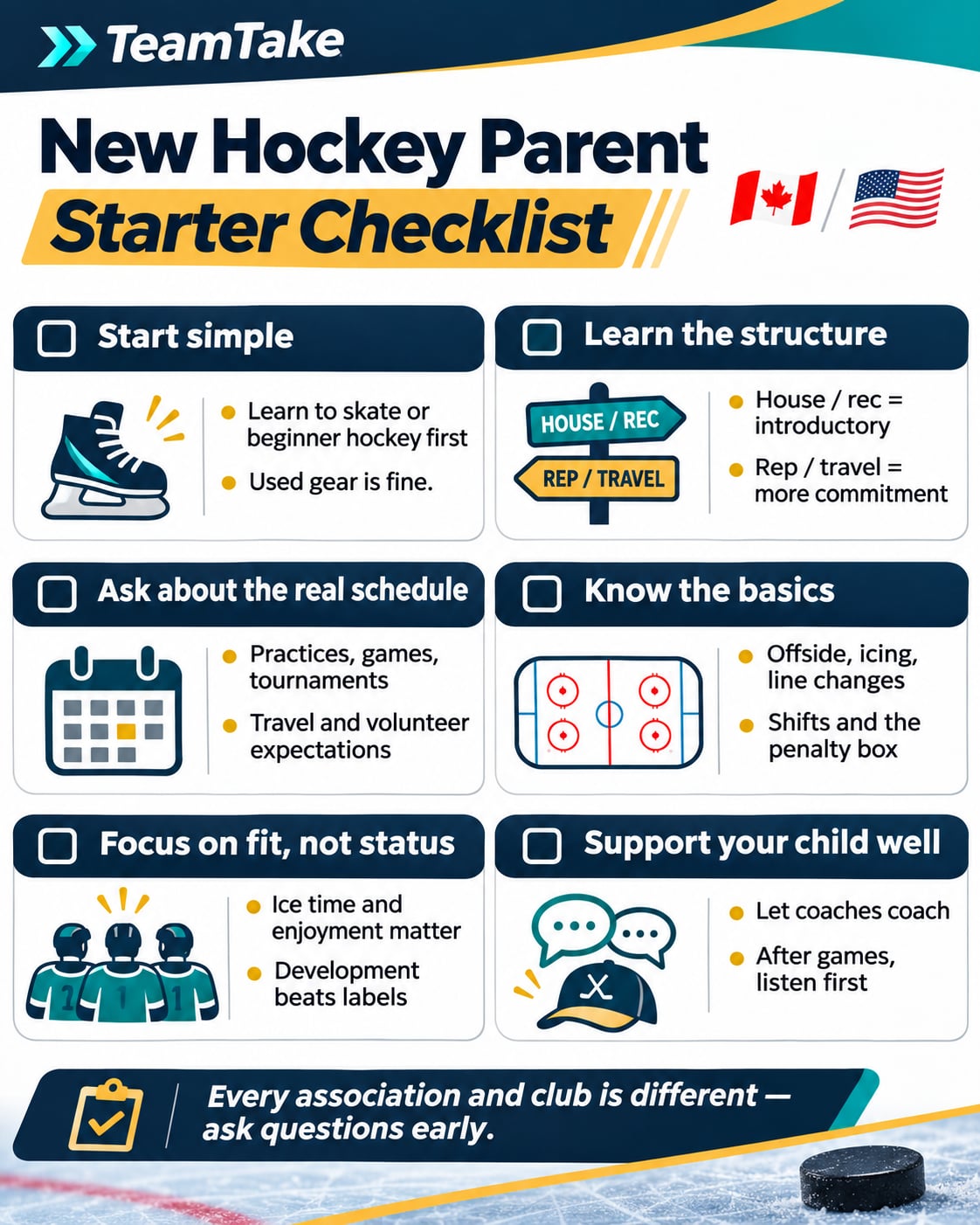
The checklist is a quick orientation, not a literal list of rules. Used equipment can be a sensible choice when it fits properly, is safe and meets applicable certification requirements; use extra caution with helmets and other protective gear. House and recreational hockey are not exclusively introductory; many experienced players choose them. Some young beginners play simplified games without icing and offside.
- Is the program appropriate for my child's current skating ability and age?
- Does the program offer a trial session, equipment loan or financial assistance?
- Which gear is required, and what is provided?
- When are practices and games, and how much travel should we expect?
- What is the full expected cost, including team fees and extras?
- How are teams formed, and is a roster spot guaranteed after registration?
- Who coaches the children, and how are playing time and positions managed?
- Can my child try goaltending without purchasing a full set of gear? Is goalie-specific instruction available if they decide to pursue the position?
- If my child eventually wants to play competitively, does the program offer enough individual skill development, or will we need to arrange additional opportunities?
- How do parents communicate with coaches and report safety concerns?
- What happens if the program is not a good fit or our child wants to stop?
A program should be willing to answer reasonable questions from a new family. You are not expected to know the answers already.
17. When should we start thinking about competitive hockey and the next level?
Not necessarily in the first season.
If your child becomes interested in competitive hockey, start learning about the local options before registration and tryout deadlines. Compare coaching quality, game opportunities, development, schedule and total cost. Not every child wants to pursue the same goal, and goals can change.
There is nothing wrong with wanting to play AAA, junior or college hockey. There is also nothing wrong with enjoying local hockey for years without pursuing those levels. A child who is excited to go to practice, develops friendships and learns how to compete has already gained something meaningful.
When your family is ready to explore further, TeamTake's Hockey Beyond U15: A Canadian Guide to Junior, College and Professional Pathways explains later competitive opportunities, including American junior and college hockey. BC families can also refer to BC Youth Hockey Pathways: From U13 to U15 AAA and Beyond.
The most important thing to remember
Experienced hockey parents were beginners once too. They had to learn how to tie skates, read a team schedule, understand the rules and work out what their children actually wanted from the sport.
Ask questions. Borrow gear when appropriate. Get to know other families. Learn to enjoy the game without judging every shift. Give your child the chance to become a hockey player at their own pace.
You don't need to have played hockey yourself to help your child have a good experience. You need curiosity, patience and a willingness to learn together.
Join the conversation on TeamTake
Experienced hockey parents: what is one thing you wish someone had told you before your child's first season?
New hockey parents: what still seems confusing? Share your questions in the TeamTake community. Please protect children's privacy and avoid identifying individual minors when discussing sensitive experiences.
Sources and further reading
This independent editorial is intended as a practical starting guide. Official league and local program rules take precedence. Age labels, safety standards, fees and administrative procedures should be confirmed for the season in which a child registers. Fact-checked November 25, 2026, against the Hockey Canada 2026–28 and USA Hockey 2025–29 playing rules, official development guidance, and published terminology examples. Local rules, availability and future changes remain subject to verification.
-
Hockey Alberta — Hockey Canada Announces Change to Age Division Names
-
Grand Valley Amateur Hockey Association — USA Hockey Removes Traditional Age Classification Names
-
USA Hockey — Game-like Practices Get the Most Out of Your Players
-
Michigan Amateur Hockey Association — Cross-border Playing Rules and Protective Equipment
-
Hockey Canada — Frequently Asked Questions by Hockey Parents
-
Hockey Canada — 2026–28 Playing Rules (Rule 3.6, 6.7 and 6.11)
-
USA Hockey — 2025–29 Official Rules and Casebook (Rules 303, 304, 306, 604, 624 and 630)
Comments
Be the first to comment.